
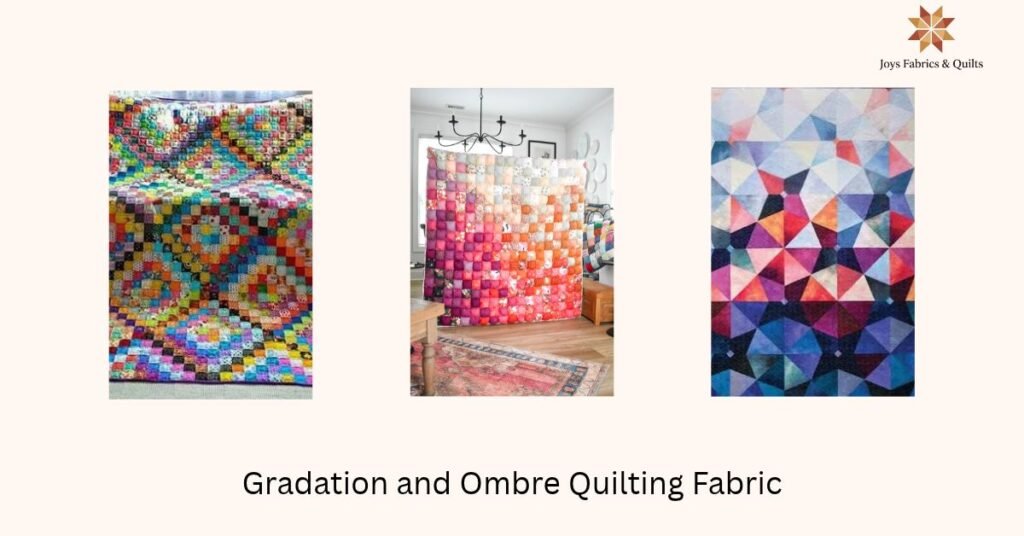
Reviewed by Team Joy’s Fabrics · Updated 24 November 2026
Gradation fabric does the shading for you. One length of cloth can carry a whole run of color, from pale to deep or from one hue into the next, so a quilt gets movement without dozens of separate fabrics. The words around it are confusing, though. Ombre, gradation, gradient: shops use them loosely, and the color does not always run the way you expect. This guide explains what each term means, how gradation fabrics are made, how to read where the color runs before you cut, and how quilters use them. It ends with the three gradation lines Joy Press stocks in Godley, Texas: Maywood Studio Gelato, Robert Kaufman Effervescence and Benartex Essential Gradations.
Key facts
- Gradation fabric is cloth printed or dyed so its color changes gradually, usually across the width from selvage to selvage.
- Ombre, from the French for “shaded”, usually means a gradation of one hue from light to dark.
- Many gradation fabrics are digitally printed; others are hand dyed.
- On some lines the color runs once across the width; on others the run repeats, such as an ombre repeat of about 22 inches that appears twice across the fabric.
- Joy’s Fabrics and Quilts stocks Gelato by Maywood Studio, Effervescence by Robert Kaufman and Essential Gradations by Caryl Bryer Fallert for Benartex.
- Effervescence is $8 a yard and Essential Gradations is $10 a yard at Joy’s, both with a half-yard minimum and free shipping in the USA.

What is gradation fabric?
Gradation fabric is quilting cloth whose color changes gradually along one direction, usually across the width from one selvage to the other. A single piece can hold a whole range of values or hues that would otherwise take many fabrics to collect.
The Quilt Show’s Quiltipedia puts it plainly: ombre fabric is light to dark across the width of the fabric. That direction matters. Cut a strip along the length and you get one color; cut across the width and you get the whole run.
Quilters use gradation fabric where they want shading without piecing it: bargello columns, backgrounds, borders. Our full explainer on what gradation fabric is goes deeper into the types.
Ombre, gradation and gradient: what the words mean
The three words overlap, and shops do not use them the same way. As a working rule, ombre is one hue moving from light to dark, while gradation and gradient can also move from one hue into another.
| Term | Usual meaning | Example |
|---|---|---|
| Ombre | One hue shading from light to dark, made by adding white (tints) or black (shades) | Pale blue to navy |
| Gradation | Any gradual change in color or value across the fabric | Yellow through orange to red |
| Gradient | Used much like gradation; some shops reserve it for multi-color shifts | A rainbow run selvage to selvage |
Ombre is the narrowest term: one hue, light to dark. Gradation and gradient cover multi-color runs too.
Missouri Star Quilt Company explains that “ombre” comes from the French word for “shaded.” The National Quilters Circle describes an ombre as one hue with tints and shades added: lighter where white was added, darker where black was added. Product names blur the lines, though. Maywood Studio calls Gelato an ombre even in multi-color colorways such as Blue to Pink to Yellow. Read the color description, not just the name.
How gradation fabric is made
Gradation fabric is made in two main ways: printed, often digitally, or dyed.
- Digital printing. The design is printed with inks that fade from one color into the next. Robert Kaufman’s Effervescence is a digital print, according to its retailers.
- Printed ombre on quilting cotton. Keepsake Quilting describes Maywood Studio’s Gelato as selvage-to-selvage ombres printed on premium quilting cotton.
- Hand dyeing. The Quilt Show notes you can make your own ombre with hand-dyeing and painting techniques.
Read the repeat before you cut
The single most useful thing to check on a gradation fabric is how the color runs across the width. Some lines run once from selvage to selvage. Others repeat the run, or step through it in stripes.
Three examples from the lines quilters ask about:
- One run across the width. Retailers of Effervescence’s single border gradation tell buyers to use the whole width of the fabric to show off the color changes.
- A repeating run. eQuilter describes one Essential Gradations colorway as an ombre fade from selvage to selvage with a pattern repeat of about 22 inches that repeats twice across the fabric.
- Stepped stripes. eQuilter describes a Gradations II colorway as an ombre sequence repeating across the width in color stripes about 4 inches wide.
This changes how you buy. Because the color runs across the width, the length you buy gives you more strips of the same run, not more colors. Plan your cutting from the width first, then order the length your pattern needs.

Gradation fabric at Joy’s Fabrics: three lines compared
Joy Press stocks three gradation lines. Each runs its color differently, so each suits different projects.
| Line | Maker and designer | How the color runs | Joy’s price | At Joy’s |
|---|---|---|---|---|
| Gelato | Maywood Studio | Selvage-to-selvage ombres on quilting cotton, about 43 to 45 inches wide | See the Gelato page | Fabric, a Shadow Cabin quilt kit and a finished booth sample quilt |
| Effervescence | Robert Kaufman, designed by Amelia Caruso | Digitally printed circles and bubbles that shift color across the width | $8 a yard, half-yard minimum | 11 colorways, several in limited quantity |
| Essential Gradations | Benartex, designed by Caryl Bryer Fallert | Ombre fades and stripes across the width | $10 a yard, half-yard minimum | 8 colorways; the colors still in stock |
Gelato gives smooth single runs, Effervescence adds texture with printed bubbles, and Essential Gradations offers repeats and stripes.
Joy’s Effervescence colorways are Autumn, Boysenberry, Celebration, Atmosphere, Nature, Gold, Red, Spice, Primary, Bright and Jewel. Her Gelato Shadow Cabin quilt kit is $100 and includes 6 yards of Gelato #904, 1.5 yards of Gelato Violet, 2 yards of Jet Black Kona and the pattern. A finished Gelato booth sample quilt is $400.
Stock on all three lines is limited, so call before you plan a large project. Shipping on fabric is free in the USA. Order by phone at 817-223-8736 or through the contact page; Joy sends a Square invoice. See the Gelato page, the Effervescence page and the Essential Gradations page for what is on hand.
How quilters use gradation fabric
Gradation fabric earns its place wherever a quilt needs shading. Four common uses:
- Bargello quilts. A gradation gives a smooth run of color with fewer fabric changes. Joy’s Two-Fabric Bargello kits pair a gradation fabric with Effervescence and Kona cotton. Our bargello quilts guide explains the method.
- Backgrounds. A light-to-dark background suggests sky, water or a sunset behind a pieced or appliquéd design.
- Sashing and borders. Designer Daphne Greig used shaded fabric for the sashing and cornerstones of her Gradation Crossing pattern, with the block pieces cut from the same fabric.
- Showing the whole run. The National Quilters Circle suggests cutting a section that shows every value and using it as a strip or large piece.
Missouri Star also notes that a jelly roll, fat quarter bundle or layer cake of ombre fabric can show the gradient well, since each piece carries part of the run.
Buying quilting fabric by the yard
The three gradation lines here come on bolts roughly 41 to 45 inches wide, according to the retailers that list them: Gelato about 43 to 45 inches, Essential Gradations about 41 to 43 inches and Effervescence about 44 inches.
Joy sells by the yard with a half-yard minimum. For gradation fabric, two points save money:
- Count strips across the width, not yards. Each cut across the width carries the full color run.
- Buy the whole project at once. Printed lines go out of production, and Joy’s gradation stock is limited.
If you want variety without yardage, precut bundles help. Our guide to the best fat quarter bundles for quilting compares them, based on our research. Our quilting fabric by the yard guide covers widths, cuts and how much to buy.
Gradation fabric questions
Is ombre fabric the same as gradation fabric?
Not quite. Ombre usually means one hue shading from light to dark. Gradation covers any gradual change, including one hue into another. Many shops use the words loosely, so read each fabric’s color description.
Is Effervescence a Maywood Studio fabric?
No. Effervescence is a Robert Kaufman fabric designed by Amelia Caruso. Gelato is the Maywood Studio line. Joy stocks both lines.
How much gradation fabric do I need for a bargello quilt?
It depends on the pattern. Joy’s Two-Fabric Bargello kits, for quilts from 33 x 53 to 46 x 57 inches, use 2 yards of gradation fabric with 1 yard of Effervescence and 1 yard of Kona cotton.
How should I wash ombre fabric?
Missouri Star recommends washing finished ombre projects in cold water to keep the colors vibrant. Follow the care instructions on the bolt end for each line.
Can gradation fabric be used for quilt backing?
Yes. Some lines come in 108-inch wide backing, such as Effervescence Wide from Robert Kaufman, so a whole quilt back can be one piece.
Your next step
Pick the run of color you want first, then the line that carries it: smooth Gelato ombres, textured Effervescence or striped Essential Gradations. Call Joy at 817-223-8736 or use the contact page to ask which colorways are still on the shelf. If you are planning a bargello, start with our bargello quilts guide. If you want to learn more about one maker, see our Maywood Studio fabric guide.
Every Fabric guide on this site
-
Maywood Studio Fabric: Collections, Quality and Where to Buy
-
Maywood Studio Gelato Ombre Fabric and the Gelato Shadow Cabin Kit
-
Quilt Backing Calculator: How Much Fabric for the Back of Your Quilt
-
Quilt Binding Calculator: Strips and Yardage for Straight or Bias Binding
-
Quilt Border Calculator: Yardage and Cutting Sizes for Up to Three Borders
-
Quilting Fabric by the Yard: Widths, Cuts and How Much to Buy
-
Quilting Fabric Calculator: Yardage for Backing, Binding, Borders and Batting
-
What Is Gradation Fabric? Step Sets, Printed Ombres and How to Use Them