
By Shariful Alam Pavel · Updated 26 November 2026
To make a bargello quilt, sew strips of fabric into a strip set in light-to-dark order, sew the set into a tube, cut the tube into rings of different widths, open each ring at a different seam, and sew the opened columns side by side so the colors step into a wave. That is the tube method most bargello patterns use. The steps below follow published tutorials from Missouri Star and others, with the cut widths, pressing and labeling habits that keep a bargello from going wrong.
Key facts
- Most bargello quilts are made with the tube method: strip set, tube, rings, open, sew.
- Many patterns start with 2½-inch strips, so a precut strip roll works well.
- Sew strips in alternating directions so the strip set stays straight.
- The width of each cut column shapes the curve: narrow columns make steep slopes, wide columns flatten them.
- Label every column as you cut it, as Missouri Star advises, so the order is never lost.

What you need to make a bargello quilt
A bargello needs the usual piecing kit plus a long ruler and a way to keep columns in order.
- Fabric. Either a set of fabrics that step clearly from light to dark (published patterns use from 9 to about 13), a precut 2½-inch strip roll sorted into a gradient, or a gradation fabric for a two-fabric bargello.
- Cutting tools. A rotary cutter, a self-healing mat and a long ruler. A Two-Fabric Bargello class list asks for a 6½ × 24½-inch ruler plus a second ruler at least 10 inches long.
- Sewing. A machine with a ¼-inch presser foot, pins and pre-wound bobbins.
- Order keepers. A marking pen, small safety pins and zip bags or numbered labels for the cut columns.
- Border, backing, batting and binding for finishing.
Step 1: Sort the fabrics into a gradient
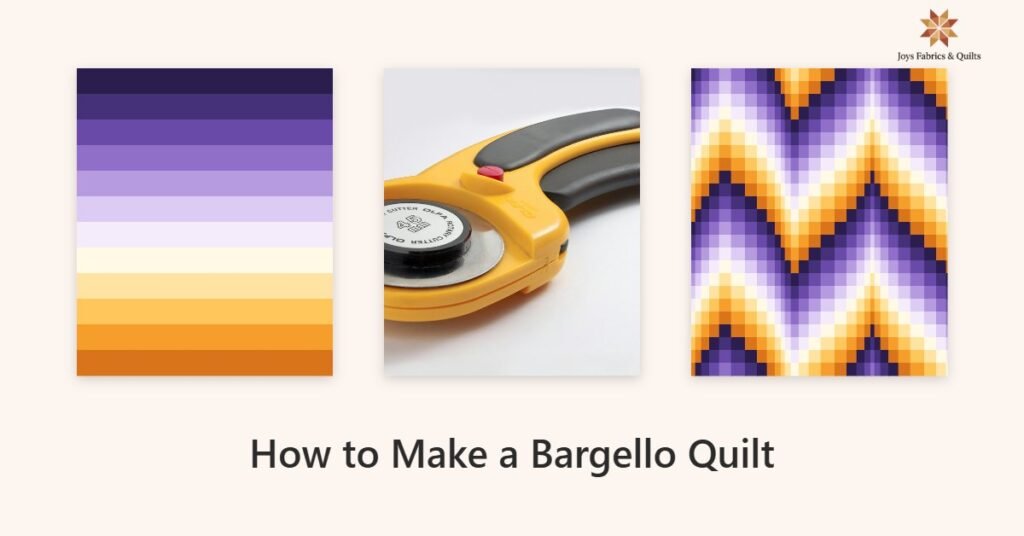
Lay your fabrics out from lightest to darkest, or from one color to another, and number them. Missouri Star’s jelly roll wave sorts a strip roll into about 12 colors, three strips per color, dark to light.
Check the steps by squinting or taking a black-and-white photo on your phone. If two fabrics look the same, swap one out; a bargello’s curve only shows where the values change. Solids and near-solids give the crispest wave, Missouri Star notes.
Step 2: Cut the strips
Cut strips across the width of the fabric, all the same width. Many bargello patterns use 2½-inch strips, which is why precut strip rolls are popular for them. Others use wider strips: one Gathered pattern cuts eight 3-inch strips from each of ten fabrics.
Cut accurately. In a bargello every strip becomes a row that has to meet its neighbor across the whole quilt.
Step 3: Sew the strips into strip sets
Sew one strip of each fabric together in order, with an accurate ¼-inch seam, to make a strip set. Make as many identical sets as your pattern calls for; Missouri Star’s wave uses three.
Alternate the sewing direction for each strip: sew the first seam top to bottom, the next bottom to top. Missouri Star does this to stop the strip set from curving. Keep the seam allowance steady, because a small error on each of 12 seams adds up to a big one across the set.
Step 4: Press the strip sets
Press each strip set carefully, without stretching it, so the seams stay straight and parallel. Some patterns, such as Gathered’s, press half the strip sets with seams one way and half the other way, so the seams nest when the columns are sewn together.
Follow your pattern’s pressing plan. The Two-Fabric Bargello class list adds a step before cutting: prewash and starch the fabric heavily, and press along the lengthwise grain.
Step 5: Sew each strip set into a tube
Fold the strip set right sides together and sew the first strip to the last, making a tube. Make sure the tube is not twisted. Now the colors run in a continuous loop, so you can start any column at any color.
Missouri Star’s wave adds one extra: a 9-inch contrast strip sewn to the lightest end of the set before the tube is closed, which becomes a bold band through the quilt.
Step 6: Cut the tube into rings of different widths
Flatten the tube on the mat, square one end, then cut rings across it in the widths your pattern lists. The cutting chart is the heart of a bargello pattern.
The widths draw the curve. Missouri Star’s wave cuts 1, 1½, 2, 2½, 3 and 3½ inches, then back down to 1 inch. A Create Whimsy tutorial steps down from 2½ to 2¼, 2, 1¾, 1½ and 1¼ inches. Narrow columns climb steeply; wide columns flatten the curve.
Stack the rings in cutting order and number each one.

Step 7: Open each ring at a different seam
Unpick one seam in each ring to open it into a column. The seam you open decides which fabric sits at the top of that column. Opening each ring one fabric higher or lower than the last makes the colors step up or down.
Follow your pattern’s chart for which fabric starts each column. Missouri Star opens each ring by unstitching one seam, shifting the starting color so the wave forms. Pin a label to each column with its number and top fabric.
Step 8: Sew the columns together
Lay out all the columns in order and check the curve from across the room before you sew. Then sew the columns together one at a time, nesting the seams and pinning at every seam intersection so the color steps stay aligned.
Press as you go, following the pattern. Sew columns into pairs, pairs into groups and groups into the top, so you are never wrestling one long, heavy piece.
Step 9: Add borders and finish the quilt
Add the border, then layer the top with batting and backing, quilt it as you like, and bind.
For the general finishing steps, our how to quilt for beginners guide covers the quilt sandwich, quilting and binding.
Common bargello mistakes and how to avoid them
Almost every bargello problem comes from order or accuracy.
| Problem | Cause | Fix |
|---|---|---|
| Strip set curves like a banana | All seams sewn in one direction | Alternate the sewing direction |
| Steps do not line up | Seam allowance drifting | Use a ¼-inch foot and check with a ruler |
| Columns in the wrong order | Rings not labeled when cut | Number each ring as you cut it |
| Wave looks flat | Fabrics too close in value | Re-sort with clear light-to-dark steps |
| Seams will not nest | Pressing plan not followed | Press strip sets as the pattern says |
Labeling and alternating seam direction prevent most bargello problems.
Two other ways to make a bargello
The tube method is the most common, but not the only one. Gathered’s bargello guide also describes an individual-rows method: cut strips, subcut them into squares or rectangles for each column, and build the columns one by one from a chart. It takes longer but suits designs that change fabric mid-column.
A two-fabric bargello uses one gradation fabric instead of a strip set of many fabrics, so the color change is printed in. See the Two-Fabric Bargello quilt pattern for how Susie Weaver’s designs work.
Bargello making questions
Is a bargello quilt hard to make?
Not hard, but exacting. The method is simple strip piecing; the challenge is accurate ¼-inch seams and keeping columns in order. Flame and wave designs are good first bargellos.
What size strips do you use for a bargello quilt?
Many bargello patterns use 2½-inch strips, the width of a precut strip roll. Some use wider strips, such as 3 inches. All strips in one strip set are the same width.
Why do you sew a bargello strip set into a tube?
A tube lets you start each column at any fabric. You cut rings from the tube and open each one at a different seam, which makes the colors step up and down into a wave.
How do you keep bargello columns in order?
Number each ring as you cut it, stack the rings in order, and pin a label with the column number and top fabric to each opened column before sewing.
How many fabrics do you need for a bargello quilt?
Published patterns use from 9 to about 13 fabrics that step from light to dark, or one precut strip roll sorted into a gradient. A two-fabric bargello uses one gradation fabric and one insert fabric.
Your next step
Choose a wave pattern from our bargello quilt patterns guide, sort your fabrics, and label everything before you cut. If you would like the fabric and pattern in one box, ask Joy about a Two-Fabric Bargello kit at 817-223-8736, or see the pattern and kits. For the history and design basics, start with our bargello quilts guide.