
By Shariful Alam Pavel · Updated 26 November 2026
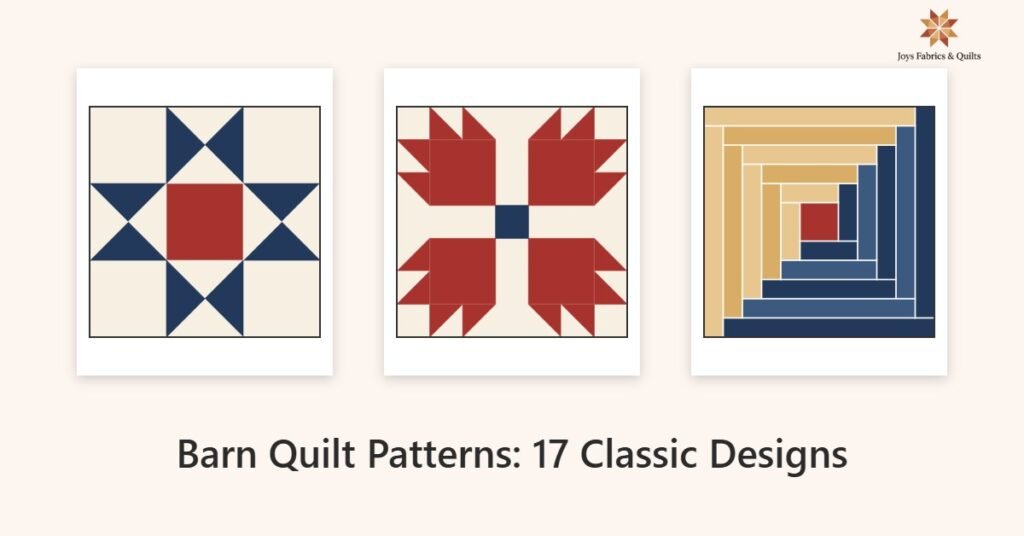
A barn quilt pattern is a single quilt block drawn on a square grid and painted large on a board. Almost every classic pattern sits on a grid of 2 × 2 up to 12 × 12 squares, and the grid decides how hard it is to paint. Fewer, bigger patches mean less taping and cleaner lines. This guide sets out 17 traditional barn quilt patterns with their grids, shows 8 of them as diagrams, and explains how to pick one that will read from where people see it.
Key facts
- Classic barn quilt patterns are traditional quilt blocks such as Ohio Star, Nine Patch, Bear’s Paw and Log Cabin.
- Each block sits on a square grid. Nine Patch and Ohio Star use 3 × 3; Sawtooth Star uses 4 × 4; Bear’s Paw uses 7 × 7.
- The easiest patterns to paint have few, large patches: Four Patch, Nine Patch, Shoofly, Friendship Star and Economy Block.
- A 2 × 2 foot board reads well from a porch; 4 × 4 and 8 × 8 foot boards are the sizes seen from the road.
- Straight-line patterns are easier to paint than curved ones.
What is a barn quilt pattern?
A barn quilt pattern is the drawing for one quilt block, scaled up to paint on a board. A fabric quilt repeats a block many times; a barn quilt shows one block, large and alone, so every line has to be clear.
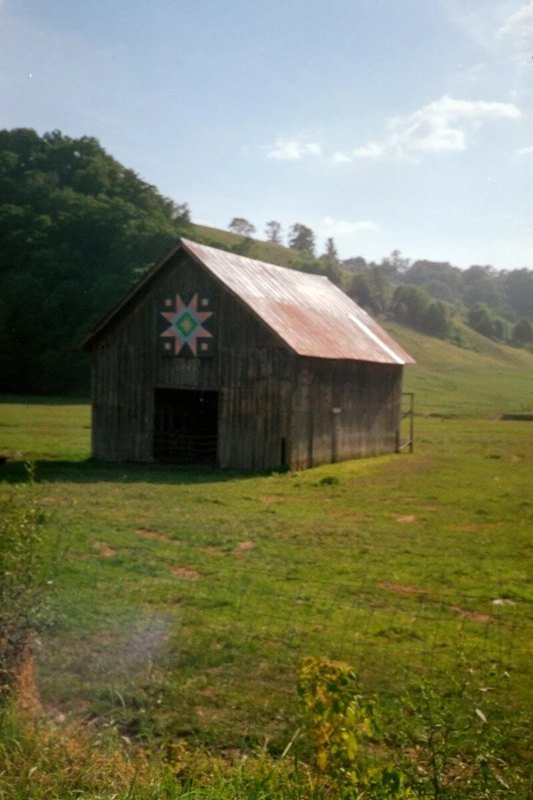
Most barn quilt patterns come straight from traditional patchwork. The first trail quilt, hung in Adams County, Ohio, in 2001, was an Ohio Star. The Adams County visitors bureau describes the Ohio Star as based on a much older pattern known as Variable Star, traditionally made in two colors and sometimes three. That is typical: the patterns are old, and the boards are new.
For the story of how barn quilts began, see our barn quilts guide.
How a barn quilt pattern is built on a grid
Every classic block divides the square into equal grid squares. You find the size of one grid square by dividing the board width by the grid count. A 24-inch board on a 3 × 3 grid gives 8-inch squares; the same board on a 4 × 4 grid gives 6-inch squares.
Inside the grid, three shapes do almost all the work:
- Squares. A whole grid square in one color.
- Half-square triangles. A grid square cut corner to corner into two colors.
- Quarter-square triangles. A grid square cut on both diagonals into four triangles, which make the hourglass shapes in stars like the Ohio Star.
The grid does not get harder on a bigger board. MadeGood Designs, which publishes a free barn quilt pattern planner, makes the point that grid squares simply grow with the board. A Bear’s Paw is fiddly on a 2-foot board and roomy on an 8-foot one.
17 classic barn quilt patterns, by grid and difficulty
The table lists 17 traditional blocks used for barn quilts. Tape lines count the lines you mask inside the board, so they are a fair measure of how much work a pattern is.
| Pattern | Grid | Grid square on a 2 ft board | Tape lines | Colors |
|---|---|---|---|---|
| Four Patch | 2 × 2 | 12 in | 2 | 2 |
| Nine Patch | 3 × 3 | 8 in | 4 | 2 |
| Ohio Star | 3 × 3 | 8 in | 8 | 3 |
| Friendship Star | 3 × 3 | 8 in | 8 | 2 |
| Shoofly | 3 × 3 | 8 in | 8 | 2 |
| Churn Dash | 3 × 3 | 8 in | 12 | 2 |
| Sawtooth Star | 4 × 4 | 6 in | 12 | 3 |
| Economy Block | 4 × 4 | 6 in | 8 | 3 |
| Pinwheel | 4 × 4 | 6 in | 8 | 3 |
| Broken Dishes | 4 × 4 | 6 in | 14 | 2 |
| Dutchman’s Puzzle | 4 × 4 | 6 in | 20 | 3 |
| Jacob’s Ladder | 6 × 6 | 4 in | 16 | 2 |
| Rail Fence | 6 × 6 | 4 in | 10 | 3 |
| Snowball | 6 × 6 | 4 in | 18 | 3 |
| Bear’s Paw | 7 × 7 | about 3.4 in | 36 | 3 |
| Flying Geese | 8 × 8 | 3 in | 74 | 3 |
| Log Cabin | 12 × 12 | 2 in | 20 | 3 |
Grid, tape-line and color counts come from MadeGood Designs’ published barn quilt planner; tape lines run from 2 for a Four Patch to 74 for Flying Geese.
The MadeGood Designs barn quilt planner prints a painting plan for each of these blocks at the board size you choose.
Easy barn quilt patterns: 4 blocks drawn on their grids
The four blocks below need the fewest tape lines on the list, so they suit a first barn quilt. The light gray lines show the grid you would pencil on the board.
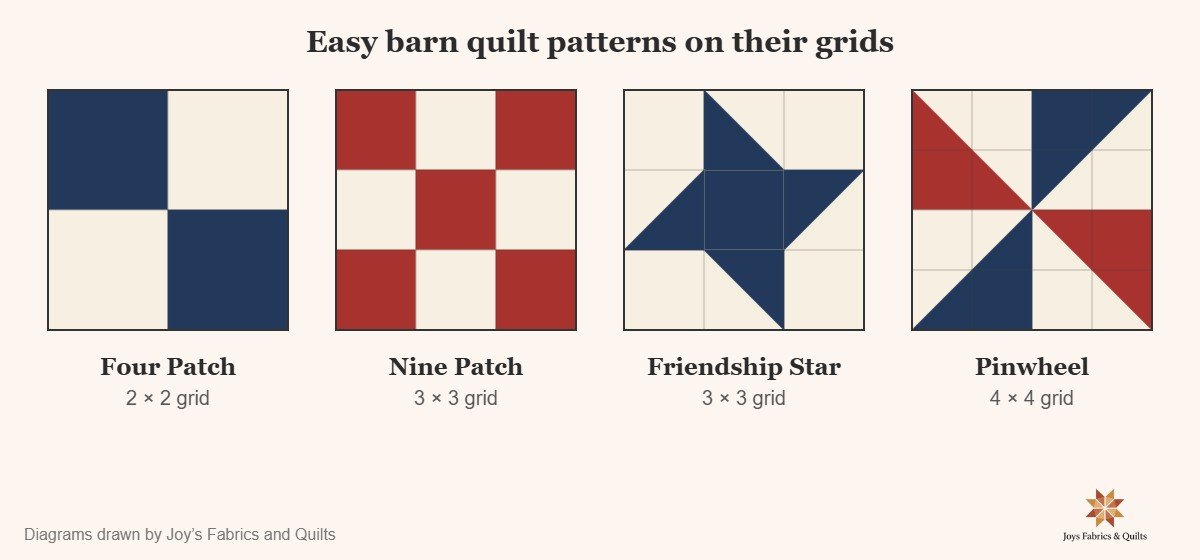
- Four Patch (2 × 2). Two colors in a checkerboard. Two tape lines.
- Nine Patch (3 × 3). Five dark squares and four light ones. A classic first block.
- Friendship Star (3 × 3). Four half-square triangles turn around a center square, so the star appears to spin.
- Pinwheel (4 × 4). Four large half-square triangles, each filling a quarter of the board, all turning the same way. Bold from a distance.
Shoofly and Economy Block belong in the same easy group. MadeGood Designs names all five, along with Four Patch, Nine Patch and Friendship Star, as the easier starting blocks because they have few, large patches.
Star and classic barn quilt patterns: 4 more blocks
These four take more taping but give the look most people picture when they think of a barn quilt.
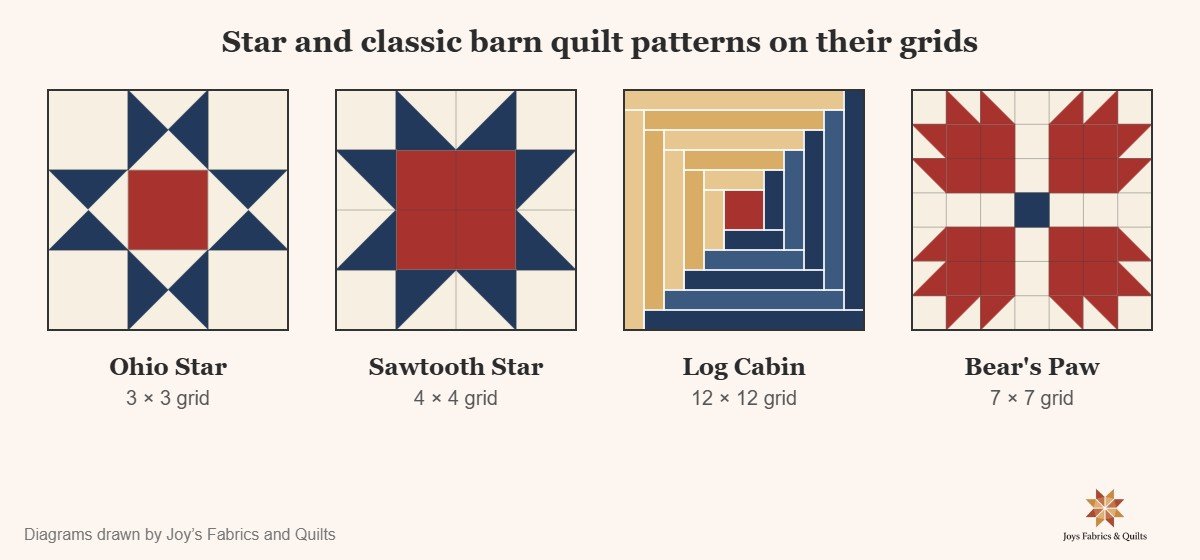
- Ohio Star (3 × 3). Four quarter-square triangle units make eight star points around a center square. The pattern of the first trail quilt.
- Sawtooth Star (4 × 4). A large center square with pairs of points on each side. Twelve tape lines.
- Log Cabin (12 × 12 strips). A center square wrapped in “logs,” dark on two sides and light on the other two, so the block splits on the diagonal.
- Bear’s Paw (7 × 7). Four paws, each a large square with small triangle claws, separated by a cross. Thirty-six tape lines.
Flying Geese sits at the top of the effort scale, with 74 tape lines on the planner’s count. It is beautiful, and it is a project for a painter who has already done one or two.
Choosing a pattern for where it will hang
Pick the pattern for the distance people will see it from. Detailed blocks need larger boards so points and corners stay crisp; simple blocks read on small boards.
| Where it hangs | Usual board | Patterns that read well |
|---|---|---|
| Porch post, fence, garden shed | 2 × 2 ft | Four Patch, Nine Patch, Friendship Star, Pinwheel |
| Garage or small barn | 4 × 4 ft | Ohio Star, Sawtooth Star, Churn Dash, Shoofly |
| Barn gable seen from the road | 8 × 8 ft | Bear’s Paw, Log Cabin, Dutchman’s Puzzle, stars with many points |
The smaller the board and the farther the viewer, the fewer pieces the pattern should have.
Two more rules come from the Columbia County, Wisconsin Extension barn quilt instructions. Choose a pattern with straight lines, because curves are harder to paint accurately. And plan a border: for an 8-foot quilt the county uses a 3-inch border, leaving 7.5 feet for the pattern.
Choosing colors for a barn quilt pattern
Choose two or three strong colors with clear contrast. Kansas State 4-H barn quilt workshop notes say primary and secondary colors are noticed better from a distance, and the Columbia County guide recommends bold colors that stand out from the road and suit the property.
Contrast matters more than the number of colors. A three-color Ohio Star in red, white and navy reads from far away; the same star in three soft tans can disappear against weathered wood. Decide which color is the background first, then give the star or main shape the strongest color you have.
Free barn quilt patterns and making a pattern your own
The 17 blocks above are traditional patterns, not owned designs, so you can paint them freely. Printable versions are easy to find; MadeGood Designs offers plans free, including for commercial use.
To make a pattern your own, keep the grid and change the color placement. Swapping which patches are dark can turn a Nine Patch into a cross or a diamond. Many trail quilts take their pattern from a quilt already in the family, which is the subject of our guide to barn quilt meanings.
For a gentler start, look for our guides to free printable barn quilt patterns and easy barn quilt patterns for beginners. And because barn patterns come from fabric blocks, our quilt blocks for beginners guide covers the same shapes in cloth.
From pattern to painted board
Once you have a pattern, the work is grid, tape and paint, one color at a time. Our step-by-step guide on how to make a barn quilt covers the board, primer, coats per color and hanging.
If you would rather hang one than paint one, Joy Press paints barn quilts by hand in Godley, Texas. Her listed Porch Art piece is 12 × 18 inches on primed MDO board, sealed with Varathane Spar Urethane, for $65. See barn quilts for sale to order, or call Joy at 817-223-8736 to ask about a pattern.
Barn quilt pattern questions
What is the easiest barn quilt pattern?
The Four Patch is the easiest: a 2 × 2 checkerboard with two tape lines and two colors. Nine Patch, Shoofly, Friendship Star and Economy Block are also easy because they have few, large patches.
What is the most popular barn quilt pattern?
The Ohio Star is the best-known barn quilt pattern. It was the first square on the original quilt trail in Adams County, Ohio, in 2001, and it is built on a simple 3 × 3 grid.
How do you scale a barn quilt pattern to a board?
Divide the board width by the pattern’s grid count. A 48-inch board on a 3 × 3 grid gives 16-inch squares; on a 4 × 4 grid, 12-inch squares. Draw the grid in pencil, then draw the shapes inside it.
Are barn quilt patterns free to use?
Traditional blocks such as Ohio Star, Nine Patch and Log Cabin are not owned by anyone, so you can paint them. A modern designer’s original pattern may carry its own terms, so check before you copy one.
What size should a barn quilt pattern be?
Match the size to the viewing distance. A 2 × 2 foot board suits a porch or garden. Barns usually take 4 × 4 or 8 × 8 foot boards so the pattern can be seen from the road.