
By Shariful Alam Pavel · Updated 26 November 2026
Most barn quilts do not carry a fixed, secret meaning. Their meaning is usually personal: a pattern from a grandmother’s quilt, a design that stands for the farm, or a block chosen for its name. Pattern names do have real stories, many drawn from farm and household life. Popular lists that give every pattern a one-line symbol mostly repeat each other without a source. And the story that quilt patterns guided people on the Underground Railroad has no historical evidence behind it.
Key facts
- The first barn quilt trail began in Adams County, Ohio, in 2001. Its first square was an Ohio Star.
- Most trail quilts take their pattern from a family quilt or from something that stands for the farm.
- Many block names come from daily life: Churn Dash is named after the parts of a butter churn.
- The same block can carry different names in different regions; Bear’s Paw has also been called Duck’s Foot in the Mud and Hand of Friendship.
- There is no documented color code for barn quilts.
- Historians have found no evidence that quilts were used as signals on the Underground Railroad.
Where a barn quilt’s meaning really comes from
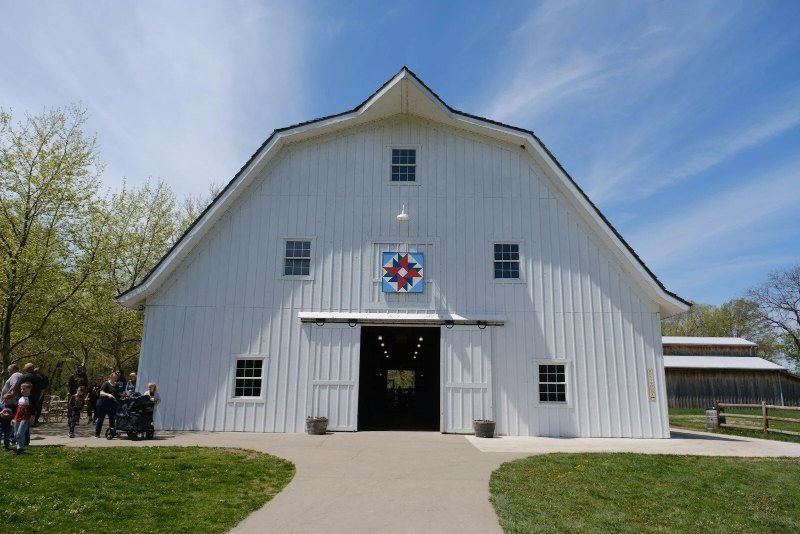
A barn quilt’s meaning almost always comes from the family that hangs it. Organizers of quilt trails describe the same pattern again and again: the design is copied from an heirloom quilt, or chosen to represent the farm.
On the Gratiot County Quilt Trail in Michigan, Greenstone Farm Credit Services reports that each barn quilt is typically drawn from a single square on an heirloom quilt, or from a design that represents the family’s farming operation. Along Oregon’s Tualatin Valley quilt barn trail, owners gave reasons ranging from a favorite quilt to a favorite crop or animal, family history, or a sunset they loved.
The movement began the same way. Donna Sue Groves wanted to honor her mother, Maxine, a quilter, with a quilt square painted on their barn in Adams County, Ohio. That idea became a community project, and the first of 20 trail squares, an Ohio Star, was dedicated on October 12, 2001, Ohio Magazine reports. Maxine’s own square, a Snail’s Trail, went up in 2003. By the time Groves and author Suzi Parron published their 2012 book on the movement, barn quilts had spread to forty-eight states and into Canada.
Groves was relaxed about rules. “There are no ‘quilt barn police,'” she told The Christian Science Monitor in 2008. Off an official trail, people can paint what they like.
How quilt block names came about
Quilt block names come mostly from everyday life, places and the imagination of the people who named them. They are names, not codes, and they were never fixed.
- Tools and chores. The Churn Dash is named for the butter churn: the churn is the container and the dash is the stirring stick, as Gathered’s guide to quilt blocks explains.
- Places. Blocks named after states and regions, such as the Ohio Star, often travel far beyond them.
- Regional renaming. A 1972 American Heritage pattern guide lists one block as Bear’s Paw in Ohio, Duck’s Foot in the Mud on Long Island and Hand of Friendship in Philadelphia.
- Names that changed over time. QuiltHistory.com traces how the block now called Drunkard’s Path went by older names such as Solomon’s Puzzle before that one stuck.
Because names moved and changed, a block’s name tells you about its history and the people who used it. It does not tell you a hidden message the maker meant.
Barn quilt patterns and their meanings
The table separates what is documented about each pattern from the popular association you will see repeated online. The popular associations are not wrong to enjoy; they are simply not historical facts.
| Pattern | Where the name or link comes from | Popular association | How sure |
|---|---|---|---|
| Ohio Star | Based on the older Variable Star, per Adams County’s trail guide; first square of the first trail | Ohio, pioneer heritage | Documented history |
| Log Cabin | So popular from 1870 to 1900 that fairs opened Log Cabin categories, quilt historian Barbara Brackman notes | Warmth, hospitality, home | Popular association |
| Churn Dash | Named for a butter churn’s container and stirring stick | Farm and household life, from its name | Documented name origin |
| Bear’s Paw | Also called Duck’s Foot in the Mud and Hand of Friendship | Varies with the regional name | Documented names |
| Drunkard’s Path | Earlier names include Solomon’s Puzzle | The winding path its name describes | Documented names |
| Flying Geese | Named for its rows of triangles, like birds in flight | Migration, journeys | Popular association |
| Barn Raising | A way of setting Log Cabin blocks; the name recalls a barn raising | Community | Popular association |
| Lone Star | A large eight-pointed star | Texas pride | Popular association |
| Snail’s Trail | Maxine Groves’s square, hung in Adams County in 2003 | Honoring a mother | Documented (Groves family) |
Lists of barn quilt meanings, such as Patchwork Posse’s, give associations like hospitality for Log Cabin and migration for Flying Geese without citing a historical source, so we label them popular associations.
Some barn quilts mix in shapes with general symbolism. Countryside magazine, for example, says a circle represents eternity and a four-pointed star stands for success and happiness. These are folk associations, like the meanings given to flowers, not a shared code that painters follow.
Do barn quilt colors have meanings?
No documented color code exists for barn quilts. The popular articles that list pattern meanings do not give sourced color meanings either.
Color is chosen for two reasons: it reads from a distance, and it means something to the owner. Kansas State 4-H barn quilt workshop notes say primary and secondary colors are noticed better from a distance. Beyond that, a family might pick school colors, the green of a favorite tractor, or the reds of the quilt the pattern came from. That choice is the meaning.
The Underground Railroad quilt code: what historians say
There is no historical evidence that quilts were hung as signals on the Underground Railroad. The International Quilt Museum, at the University of Nebraska-Lincoln, calls the quilt code one of the most powerful quilt myths of recent years.
The story became widely known through the late-1990s book Hidden in Plain View by Jacqueline Tobin and Raymond Dobard, which drew on one family’s oral tradition. The museum notes that historians have found no other evidence to support it, and that signals such as songs, whistles and lanterns are far better documented. It cites quilt historian Barbara Brackman: people did remember quilts during escapes, but as warmth or to hide someone, not as coded messages.
NPR reported in 2024 that quilters still make Underground Railroad quilts and treasure the story. Scholar Tracy Vaughn-Manley told NPR there is no evidence of it at all. Both things can be true: the quilts are meaningful today, and the code is not history.
If you see Jacob’s Ladder, Flying Geese or Bear’s Paw on a barn, the owner may simply love the pattern.
How to choose a barn quilt pattern with meaning
Start with your own story, then find a pattern that fits it. This is how most trail quilts are chosen.
- Look in the family. A square from a grandmother’s quilt is the most common source of meaning on quilt trails.
- Think about the land. Crops, animals, a creek or the view from the porch can all suggest a pattern name or a color.
- Use a name that says something. Friendship Star for a gift, Log Cabin for a new home, a star named for your state.
- Write it down. Many trails post a short story with each quilt. Even on your own barn, a few lines on a card keep the meaning with the quilt.
- Make sure it reads. A meaningful pattern still has to be clear from where people stand. Our guide to barn quilt patterns ranks 17 classic blocks by how easy they are to paint and see.
For more on how barn quilts began, see our barn quilts guide. Our guides to what a barn quilt is, why barns have quilt patterns on them, and the history of quilting in America go further.
A barn quilt painted for you
If you have a pattern with meaning and would rather not paint it yourself, Joy Press paints barn quilts by hand in Godley, Texas. Her listed Porch Art piece is 12 × 18 inches on primed MDO board, sealed with Varathane Spar Urethane, for $65. See barn quilts for sale, or call Joy at 817-223-8736 to talk about a pattern that matters to you. If you would rather make it, our guide on how to make a barn quilt walks through every step.
Barn quilt meaning questions
What do barn quilts symbolize?
Barn quilts usually symbolize the family or farm that hangs them: an heirloom quilt pattern, the farm’s crops or animals, or a person being honored. Together, quilt trails honor farm and quilting heritage in a community.
What is the meaning of the Ohio Star barn quilt?
The Ohio Star was the first square on the first quilt trail, in Adams County, Ohio, in 2001. The county’s trail guide says it is based on an older pattern called Variable Star.
Do barn quilt colors mean anything?
No documented color code exists for barn quilts. Colors are chosen to read from a distance and to suit the owner, such as matching a family quilt or school colors.
Were barn quilts used on the Underground Railroad?
No. Historians have found no evidence that quilts were used as signals on the Underground Railroad. The International Quilt Museum treats the quilt code as a folk story from one family’s oral tradition.
Can I pick any pattern for my barn quilt?
Yes. Off an official trail, you can paint any pattern you like. Many people choose a pattern from a family quilt or one whose name fits their story.