

By Shariful Alam Pavel · Updated 26 November 2026
A quilt block is a single pieced unit, usually square, that repeats to make a quilt top. The best quilt blocks for beginners are the four-patch, nine-patch and rail fence, which use only squares and strips with straight seams, followed by the half-square triangle, pinwheel and sawtooth star, which add triangles and matching points. This guide explains finished and unfinished sizes, gives exact cutting for each block at 12 inches finished, and shows the order to learn them so each block teaches one new skill.
Key facts
- Block sizes are given as finished size; the unfinished block is ½ inch larger, so a 12-inch block measures 12½ inches before it is sewn in.
- All piecing uses a ¼-inch seam allowance.
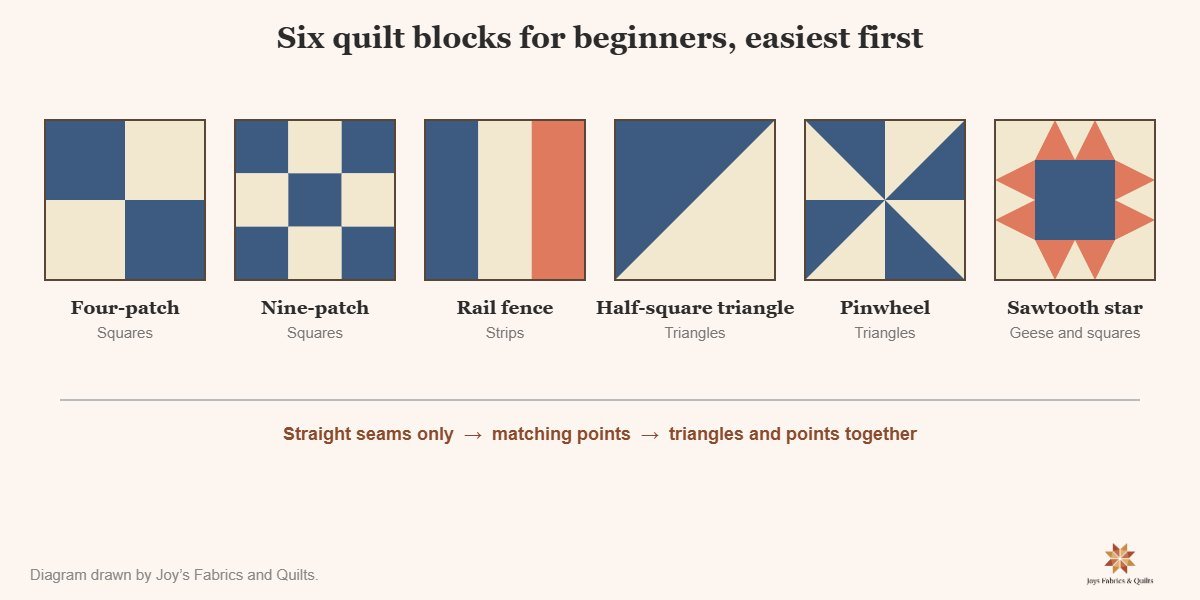
- Learn in this order: four-patch, nine-patch, rail fence, half-square triangle, pinwheel, sawtooth star.
- For half-square triangles made two at a time, cut squares ⅞ inch larger than the finished unit.
- Flying geese made four at a time use one square 1¼ inches larger than the finished width and four squares ⅞ inch larger than the finished height.
- Many painted barn quilt designs come from these same blocks.
Finished size versus unfinished size
Every block pattern gives a finished size: the size it shows in the quilt after seams. Because each outer edge loses ¼ inch to a seam, the block you sew is ½ inch larger. A 12-inch finished block measures 12½ inches unfinished.
Measure every block before you join it. Blocks that come out a little large can be trimmed; blocks that come out small usually mean the seam allowance is too wide.
Cutting chart: six blocks at 12 inches finished
| Block | Pieces to cut | New skill |
|---|---|---|
| Four-patch | 4 squares, 6½ × 6½ in (2 light, 2 dark) | Straight seams, nesting one seam |
| Nine-patch | 9 squares, 4½ × 4½ in (5 dark, 4 light) | Matching four seam intersections |
| Rail fence | 3 rectangles, 4½ × 12½ in | Sewing long, straight strips |
| Half-square triangle units | Squares cut ⅞ in larger than the finished unit | Sewing on the bias, trimming units |
| Pinwheel | 2 light and 2 dark squares, 6⅞ × 6⅞ in, making four 6-inch units | Matching a center point |
| Sawtooth star | 1 center square 6½ in; 4 corner squares 3½ in; 1 square 7¼ in and 4 squares 3⅞ in for four flying geese | Points and flying geese |
Sizes assume ¼-inch seams. Cut accurately and check each unit before sewing it into the block.
Four-patch
Two light and two dark squares, sewn into two pairs, then joined. Press the seams of each pair in opposite directions so the center seam nests. It teaches the most basic skill in quilting: a straight, accurate seam.
Nine-patch
Nine squares in three rows of three, usually alternating dark and light. The new skill is matching four seam intersections at once. Press the seams of the middle row the opposite way from the outer rows so they nest.
Rail fence
Three strips sewn side by side. Rail fence blocks are quick and look striking when turned in alternate directions across a quilt. They are good practice for sewing long seams without stretching the fabric. Strip sets also prepare you for bargello, which uses long strip sets too; see our guide on how to make a bargello quilt.
Half-square triangles
A half-square triangle, or HST, is a square made of two triangles. The usual two-at-a-time method:
- Cut one light and one dark square, each ⅞ inch larger than the finished unit you want.
- Draw a diagonal line on the back of the light square.
- Place the squares right sides together and sew ¼ inch on each side of the line.
- Cut on the line, press, and you have two units.
Because the sewn edge runs on the bias, handle the units gently and press without pushing the iron. Many quilters cut squares a little larger and trim the units to exact size.
Pinwheel
Four half-square triangle units turned so the dark triangles spin around the center. Cut two light and two dark 6⅞-inch squares to make four 6-inch finished units, then sew them into a 12-inch block. The challenge is matching the eight points at the center.
Sawtooth star
A center square with a flying geese unit on each side and a plain square in each corner. For a 12-inch star, the four-at-a-time flying geese method uses one 7¼-inch background square and four 3⅞-inch star squares to make four 3 × 6-inch geese. Add a 6½-inch center and four 3½-inch corners. This block brings together everything the earlier blocks teach.
From blocks to a quilt
Once you can sew a block, a quilt is just blocks in rows. Decide the quilt size, divide by the block size, and make that many blocks. Twelve 12-inch blocks set 3 across and 4 down make a 36 × 48-inch top before borders. Our guide on how to make a quilt step by step walks through layering, quilting and binding.
Quilt blocks and barn quilts
Many painted barn quilts copy these blocks at a large scale. The Ohio Star, Sawtooth Star and pinwheel shapes appear on barns across the country. See our barn quilt patterns guide for the painted versions.
Quilt blocks for beginners questions
What is the easiest quilt block for a beginner?
The four-patch. It uses four squares and straight seams, so you can focus on an accurate ¼-inch seam.
What size should quilt blocks be?
Common finished sizes are 6, 8, 10 and 12 inches. Larger blocks mean fewer seams and a faster quilt.
What is the difference between finished and unfinished block size?
The unfinished block is ½ inch larger, because ¼ inch is lost to the seam on each edge.
How do you make half-square triangles?
Cut two squares ⅞ inch larger than the finished unit, sew ¼ inch each side of a diagonal line, then cut on the line to get two units.
What block should I learn after the nine-patch?
The rail fence, then the half-square triangle, which leads to the pinwheel and the sawtooth star.
Your next step
Make one four-patch and measure it. If it is 12½ inches, move on to the nine-patch. For the full beginner path, start with our how to quilt for beginners guide.