

By Shariful Alam Pavel · Updated 26 November 2026
Gradation fabric is quilting fabric that moves gradually from one value or color to another. It comes in two forms. A step set is a pack of separate fabrics, each one a single shade, dyed so they step evenly from light to dark or from one color to the next. A printed gradation is one fabric whose color changes across its width, from selvage to selvage. Both let a quilter shade a design without hunting for dozens of matching fabrics. This page explains the two forms, how they are made, the kinds of gradation, and how to choose and use them.
Key facts
- Gradation fabric comes as step sets (separate pieces) or as single printed gradations (one fabric).
- Step sets are often hand dyed and sold in packs of 4, 5, 7 or 8 steps.
- Printed gradations shade across the width, either in one run or in a repeating sequence.
- A value gradation stays in one color and moves light to dark; a hue gradation moves from one color to another.
- Caryl Bryer Fallert began dyeing her own gradations in 1984 and later designed the Gradations line for Benartex.
- Joy’s Fabrics and Quilts stocks three printed gradation lines: Gelato, Effervescence and Essential Gradations.
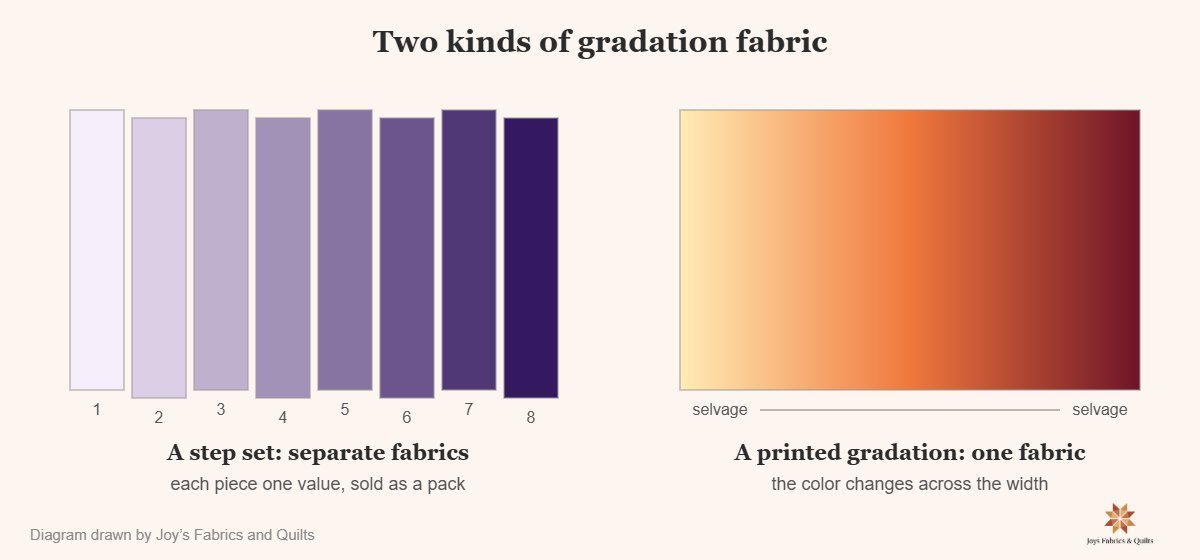
The two forms of gradation fabric
The word covers two quite different products, and shops do not always say which one they mean.
| Step set | Printed gradation | |
|---|---|---|
| What you get | Several separate fabrics, one shade each | One fabric that changes color across the width |
| Typical sizes | Fat eighths, fat quarters or half yards per step | Sold by the yard, about 41 to 45 inches wide |
| How it is made | Usually hand dyed in a series of dye baths | Printed, often digitally |
| Best for | Blocks and strips that need clear steps | Smooth shading, bargello columns, backgrounds |
| Where the steps are | Between pieces of fabric | Inside one fabric, so the cut decides the color |
A step set gives you clear, separate values; a printed gradation gives you a continuous fade.
Step sets: hand-dyed gradations
A step set is a bundle of fabrics dyed in even steps. Hand dyers sell them in a fixed number of steps. Cherrywood Hand Dyed Fabrics, for example, sells packs of 4 or 8 steps in 18 × 22-inch pieces. Smaller dyers offer 5-step and 7-step packs in fat eighths, fat quarters or half yards.
The texture varies with the method. One dyer explains that low water immersion dyeing, with Procion MX fiber reactive dyes, leaves a mottled, tone-on-tone texture with lighter and darker areas. That texture makes each step read as a semi-solid rather than a flat solid, so step sets often work like batiks or blenders.
Because hand-dyed fabric is made in small batches, dye lots can differ. One dyer notes she does not guarantee that different dye lots match, so buy every step you need for a project at the same time.
Printed gradations: ombre by the yard
A printed gradation carries the whole run in one fabric. The color shifts across the width, so a strip cut from selvage to selvage includes every shade, and a strip cut along the length stays in one shade.
The run is laid out in different ways. eQuilter describes one Essential Gradations colorway as a fade with a repeat of about 22 inches that appears twice across the fabric, and another as a mirror-image sequence of color stripes about 4 inches wide. Before you cut, look at the whole width and find where each color sits.
Joy Press stocks three printed lines in Godley, Texas: Maywood Studio’s Gelato, Robert Kaufman’s Effervescence and Benartex’s Essential Gradations by Caryl Bryer Fallert. Our gradation and ombre quilting fabric guide compares how each line runs its color.
Value gradations and hue gradations
Gradations move in one of two directions, and many sets combine both.
- Value gradation. One color from light to dark, such as pale pink to deep red. Dyers sometimes call these tone-on-tone gradients.
- Hue gradation. One color into another, such as yellow through orange to red, or a full rainbow.
- Combined sets. Some packs give several related colors, each in its own light-to-dark steps. One dyer’s pink-to-purple bundle offers 5 colors in 3 shades each, 15 pieces in all.
For piecing, value does most of the work. A design reads from across the room when the values step clearly. If two neighboring steps look the same in a black-and-white photo, the gradation will look flat in the quilt.

Where gradation fabric came from in quilting
Quilters have long sorted their own fabrics into light-to-dark runs. Hand-dyed gradations made it easier. Caryl Bryer Fallert, one of the best-known gradation quilters, writes that she started dyeing fabric in 1984 because she could not find the colors she wanted in commercial fabric. For several years she dyed solid gradations, light to dark and color to color.
In 2002 she began designing fabric for Benartex based on her hand-painted fabric, and later a line meant to be used the way she used her hand-dyed gradations. That line is called Gradations, and Essential Gradations is one of its collections.
How to choose gradation fabric
Match the form to the job:
- For blocks and strip piecing, choose a step set. Each piece is a single value, so blocks are easy to plan.
- For smooth shading, choose a printed gradation. Bargello columns, skies and borders benefit from the continuous fade.
- For texture, choose hand-dyed steps. The mottling reads like a batik.
- For a bold contrast, pair a gradation with a solid. Joy’s Two-Fabric Bargello kits pair a gradation with Effervescence and Jet Black Kona.
Check the run before you commit. For a step set, lay the pieces in order and squint. For a printed gradation, ask the shop where the color starts and stops across the width.
How quilters use gradation fabric
Gradation fabric is most at home in designs built on light and shade:
- Bargello. Each column needs a run from light to dark. A step set supplies it as separate strips; a printed gradation supplies it within one fabric. Our bargello quilt patterns guide shows designs that use both.
- Landscape and art quilts. Dyers suggest gradations for sky and water.
- Log Cabin and Courthouse Steps. Light and dark sides of each block can step through a set.
- Borders and sashing. A fade frames a quilt without a hard line.
Gradation fabric questions
What is the difference between ombre and gradation fabric?
Ombre usually means one fabric that shades from light to dark. Gradation covers both one-fabric shading and sets of separate fabrics that step in value or color.
What is a gradation fabric set?
A pack of separate fabrics, each one shade, dyed to step evenly in value or color. Packs commonly come in 4, 5, 7 or 8 steps.
Is gradation fabric hand dyed?
Some is. Step sets are often hand dyed, while yardage gradations such as Gelato, Effervescence and Essential Gradations are printed.
How do I keep a gradation looking smooth in a quilt?
Check that every step is clearly different in value, keep the pieces in order as you cut, and for printed gradations cut across the width so each strip holds the full run.
Where can I buy gradation fabric by the yard?
Joy’s Fabrics and Quilts sells Gelato, Effervescence and Essential Gradations by the yard, with free shipping in the USA. Call 817-223-8736 to check colors.
Your next step
Decide whether your project needs clear steps or a smooth fade, then choose the form. To see the printed gradations Joy has, start with the Gelato page or the Essential Gradations page, or call Joy at 817-223-8736.