
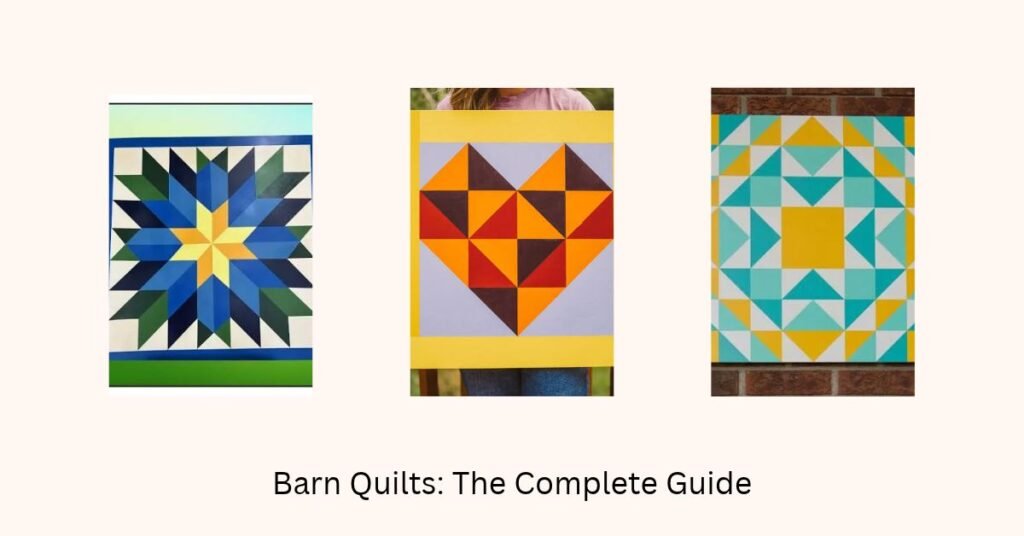
You drove past a barn with a big, bright square on its wall, and it looked like a quilt block. It is one. A barn quilt is a single quilt block, painted large on a weatherproof board and hung where people can see it. The tradition is younger than it looks: the first organized trail began in Ohio in 2001.
Below you’ll find what barn quilts are and how they differ from hex signs. You’ll also find the two stories most guides get wrong, what the patterns mean, and the boards and sizes makers use. Then come where makers disagree on sealing, and what to check before you buy one, including the ones painted at Joy’s studio in Godley, Texas.
Key facts
- The first barn quilt on an organized trail was dedicated on October 12, 2001, in Adams County, Ohio.
- That first square was an Ohio Star at a local herb fair; the Groves family’s own Snail’s Trail went up on their barn in 2003.
- Barn quilts have spread to forty-eight US states and several Canadian provinces, according to Ohio University Press.
- Common sizes run from 2 by 2 feet to 8 by 8 feet.
- One university extension guideline says “DO NOT put a sealer or varnish on the quilt”; other makers seal with spar urethane.
- The 12 by 18 inch Porch Art barn quilt from Joy’s Fabrics and Quilts is painted on MDO board and costs $65.
What is a barn quilt?
A barn quilt is a painted copy of a single quilt block, made on a weatherproof board and hung on the outside of a barn or other building. It is a painting, not fabric, so nothing on it is sewn.
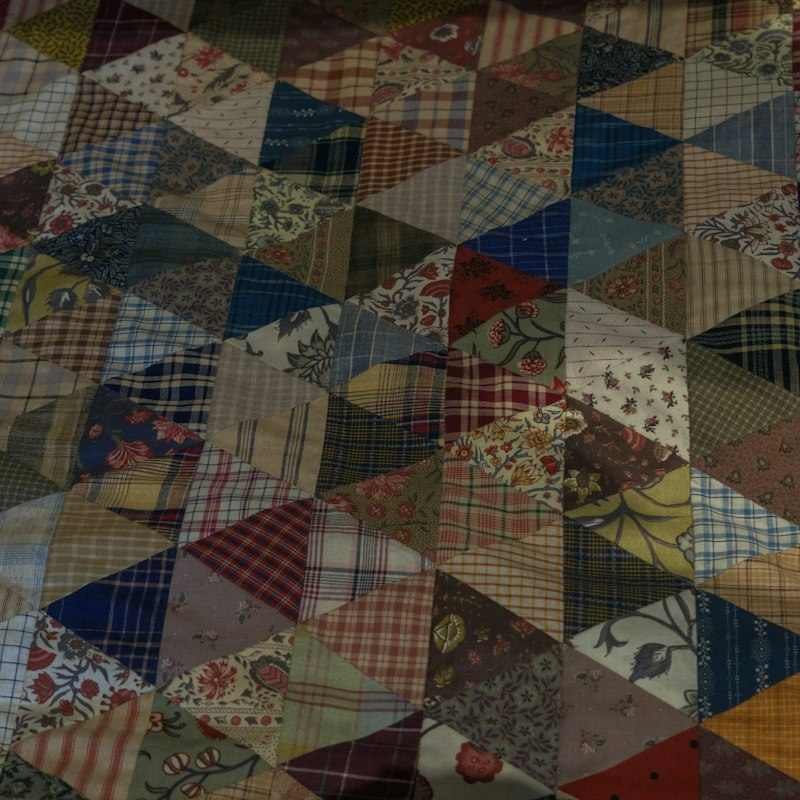
A quilt block is one square unit of a cloth quilt. Quilters sew many blocks together to make a quilt top. A barn quilt takes one block and paints it big, in flat, solid colors, so it can be read from a road. Barn quilts hang on barns, houses, garages and other buildings.
Because a barn quilt is a painting, you care for it like an outdoor sign, not like a quilt. Sun, rain and moisture getting into the board’s edges are what wear it out. That is the trade-off: paint cannot show the soft color changes of printed fabric. Makers work in solid blocks of color instead, and bold primary and secondary colors read better from a distance.
In one line: a barn quilt is a painted copy of a quilt block on a board, not a fabric quilt and not a Pennsylvania Dutch hex sign.
The squares carry a story about family and place, which is covered in why barns have quilt patterns.
Barn quilts and hex signs: what separates them
Barn quilts and hex signs are different folk arts. Hex signs are Pennsylvania Dutch star-and-rosette paintings with roots in the 1800s. Barn quilts copy cloth quilt blocks and spread from Ohio after 2001.
Hex signs belong to Pennsylvania Dutch culture. Eric Claypoole, a Pennsylvania hex sign painter, told the Philadelphia Inquirer in 2008 that hex signs are “strictly Pennsylvania Dutch,” not Amish or Mennonite. He also drew a line between hex signs, painted on boards fastened to barns, and barn stars, painted directly on the barn wall. Barn decoration came late: before the 1830s, the cost of paint meant most Pennsylvania barns went unpainted.
People search for “Amish barn quilt patterns,” but the barn quilt movement has no documented Amish origin. It began with a community project in Ohio in 2001.
Where barn quilts came from
Barn quilts as a public movement began in Adams County, Ohio, where Donna Sue Groves and her neighbors planned a driving trail of 20 painted quilt squares. The first square was dedicated on October 12, 2001.

Groves wanted to honor her mother, Nina Maxine Groves, a noted quilter, with a painted quilt square on the family barn. Her neighbors turned the idea into a trail meant to bring visitors through the county.
Here is the part most retellings get wrong. The first square did not go on the Groves barn. It was an Ohio Star, unveiled at the Lewis Mountain Olde Thyme Herb Fair. Maxine Groves got her own square, a Snail’s Trail, in 2003.
The idea spread. Author Suzi Parron documented it in Barn Quilts and the American Quilt Trail Movement (Ohio University Press, 2012). Her publisher now says barn quilts have reached forty-eight states and several Canadian provinces.
One more story needs correcting. Some say quilts carried coded escape routes on the Underground Railroad. The idea became widely known through the 1999 book Hidden in Plain View, by Jacqueline Tobin and Raymond Dobard. Historians say they have found no evidence quilts were used that way. Painted barn quilts began in 2001, so they have no link to that story either way.
The full timeline is in barn quilt history.
What do barn quilt patterns mean?
A barn quilt pattern means what its owner chooses it to mean. Many families pick a block from a quilt in their own family. Our research found no historical source that fixes one meaning to each pattern.
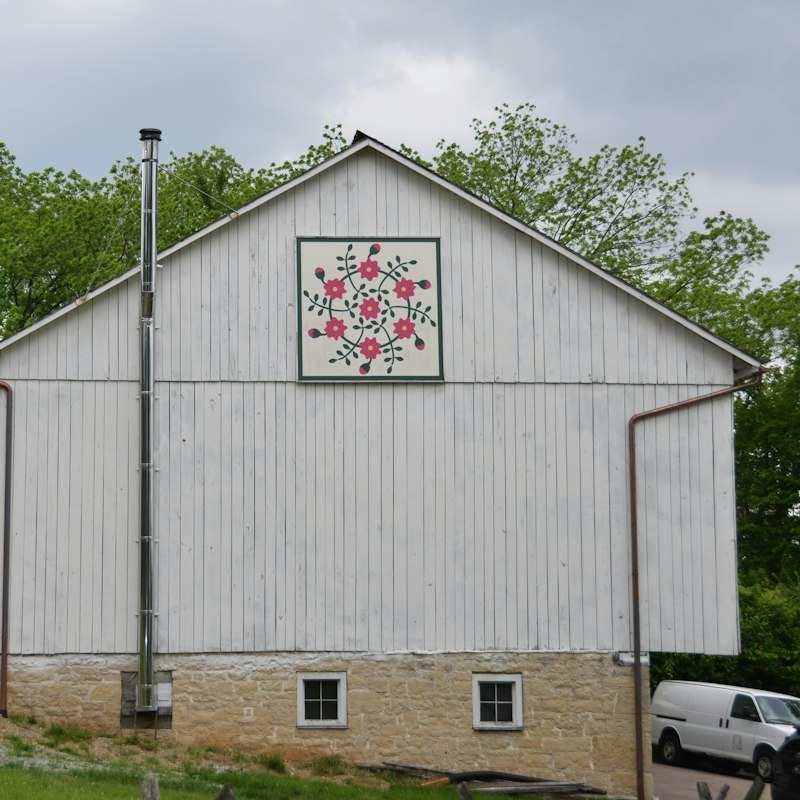
The first barn quilt project shows how this works. Donna Sue Groves chose a square to honor her mother, a quilter. Taste of Home describes the same habit across trail communities: a family’s own quilt pattern often becomes the square on its barn.
You will find charts online that give every pattern a fixed meaning, and every color a feeling. Treat them as ideas, not rules. Our research found no historical record that ties one meaning to one pattern.
So skip the question “what does this pattern mean?” Ask “what do I want my square to say?” A pattern from a family quilt, a block named for your state, or simply colors you love are all honest answers.
For pattern-by-pattern notes, see barn quilt meanings. For classic designs and their grids, see barn quilt patterns.
Barn quilt sizes and materials
Barn quilts are usually square, from 2 by 2 feet for porches to 8 by 8 feet for barns. Makers paint them on exterior plywood, MDO sign board or aluminum composite panels, using exterior paint.

Size follows distance. A block meant to be read from a county road needs to be big. An 8 by 8 foot block is built from two 4 by 8 foot sheets. A porch, fence or garden shed takes a 2 by 2 foot block. Smaller pieces work too, such as the 12 by 18 inch Porch Art painted at Joy’s Fabrics and Quilts.
| Board | What it is | Prep before paint | Noted by |
|---|---|---|---|
| Exterior plywood (AB grade) | Layered wood sheet with one smooth face | Wood filler, then two coats of primer on both faces and every edge | UW–Madison Extension, Lincoln County guideline |
| MDO (medium density overlay) | Plywood with a resin-paper face, made for outdoor signs; not MDF | Prime before painting | Kansas State 4-H; Joy’s Fabrics and Quilts |
| Aluminum composite panel | Aluminum skins over a solid core | Arrives pre-painted | Alabama Barn Quilt Trail |
Trails have changed boards over time. The Alabama Barn Quilt Trail started on 4 by 8 foot sheets of exterior plywood, then switched to composite aluminum sheets, which arrive already painted.
The full size guide is in barn quilt sizes.
How is a barn quilt made?
A barn quilt is made in five stages: prime the board, draw the block, tape each shape, paint one color at a time, then finish and hang it. Prime every edge, because moisture enters there.

- Prime. The Lincoln County guideline from UW–Madison Extension calls for two coats of white primer on both sides and every edge.
- Draw. Mark the block’s grid and shapes on the primed face.
- Tape. Tape the edges of the first color’s shapes.
- Paint. Use high-quality exterior semi-gloss latex, one color at a time, at least three coats per color. Light colors such as yellow may need four or five. Let each coat dry overnight.
- Finish and hang. Mount the block level, with 2-inch rust-proof screws.
The finish is where makers disagree. The same Lincoln County guideline is blunt about it: “DO NOT put a sealer or varnish on the quilt after it is painted.” Joy’s Fabrics and Quilts does the opposite and seals its barn quilts with Varathane Spar Urethane. Both methods are in use. Pick one on purpose, not by accident.
Step-by-step detail is in how to make a barn quilt. The paints, tape and brushes are in our barn quilt supplies list.
Buying a hand-painted barn quilt
A hand-painted barn quilt is priced by size, board and detail. Joy’s Fabrics and Quilts paints them in Godley, Texas, on primed MDO board sealed with spar urethane; the 12 by 18 inch Porch Art piece is $65.

Before you buy any barn quilt, from anyone, ask five things:
- Board. Plywood, MDO or aluminum composite?
- Edges. Were the edges primed and painted? Moisture enters there.
- Paint. Exterior paint, and how many coats per color?
- Finish. Sealed or unsealed, and with what?
- Size. Will it read from where people will see it?
Here is how Joy’s barn quilts answer those questions. Each one is hand-painted at the studio in Godley, Texas, on MDO board that is primed, painted, and sealed with Varathane Spar Urethane. The 12 by 18 inch Porch Art piece is $65. Shipping on barn quilts is quoted per order.
There is no online cart. To order, call 817-223-8736 or send an email, and Joy sends a Square invoice.
What Joy does not offer yet matters just as much. The website lists one size today. For other sizes, custom colors, lead time and returns, call or email before you order. If you want a full 8 by 8 foot barn block, ask before you order; a painter near you also saves shipping a board that large.
See the current pieces in barn quilts for sale, or start a design with custom barn quilts. If you are still choosing a pattern, the free barn quilt patterns are a good first step.
If you would rather see barn quilts in place before choosing, the next step is a quilt trail.
Where to see barn quilts: quilt trails
A barn quilt trail is a set of quilt blocks mounted along a route, so you can drive or walk from one to the next. The first, in Adams County, Ohio, had 20 squares. Trails now run in forty-eight states.
Trail maps by state are in barn quilt trail. If you would rather sew a block than paint one, start with quilt blocks for beginners.
Barn quilt questions
Can you put a barn quilt on a house?
Yes. Barn quilts hang on houses, garages, sheds and other buildings, not only barns.
How long does a barn quilt last?
Our research found no source that gives a measured lifespan. How long one lasts depends on the board, how well the edges are sealed against moisture, and the paint.
Do you have to seal a barn quilt?
Makers disagree. A UW–Madison Extension guideline says not to seal or varnish; Joy’s Fabrics and Quilts seals with spar urethane.
Who made the first barn quilt?
The first square on an organized trail was an Ohio Star, dedicated on October 12, 2001, in Adams County, Ohio. The trail was led by Donna Sue Groves.
Are barn quilts Amish?
The barn quilt movement has no documented Amish origin. It began with a community trail in Adams County, Ohio, in 2001. The Amish do not use hex signs either.
Your next step
Pick your path. If you want to paint one yourself, choose your block first, then work through how to make a barn quilt with a primed board and exterior paint.
If you want one painted for you, decide where it will hang and how far away people will stand. That sets the size. Then look at barn quilts for sale, or call Joy at 817-223-8736 to talk through colors and size before she sends an invoice.
Still deciding? Drive a quilt trail near you. A few dozen squares on real buildings will show you which one belongs on yours.
Every Barn Quilts guide on this site
-
Barn Quilt Meanings: What the Patterns Symbolize, and What They Don’t
-
Barn Quilt Patterns: 17 Classic Designs, Grid Layouts and How to Choose
-
Barn Quilts for Sale: Hand-Painted in Texas, Shipped Across the USA
-
How to Make a Barn Quilt: Step-by-Step Guide
-
Painted Barn Quilts: What Hand-Painted Means and How to Judge a Finished Piece