
By Shariful Alam Pavel · Updated 27 November 2026
Your first quilt pattern decides whether you finish your first quilt. Choose one with tiny points, curved seams or forty different fabrics, and the project can stall in a drawer. Choose one with big squares and straight seams, and you will have a finished quilt on the couch in a few weekends. A good beginner quilt pattern uses squares, rectangles or strips, straight seams, a quarter-inch seam allowance and few fabrics. It finishes at a size you can quilt on a home machine. This guide ranks ten beginner patterns from easiest to slightly harder, explains what makes each one beginner-friendly, and shows where a Two-Fabric Bargello fits.
Key facts
- The easiest first quilts use only squares, rectangles or strips with straight seams.
- A quarter-inch seam allowance is standard in quilting patterns.
- Fewer fabrics mean fewer decisions; Joy Press’s Two-Fabric Bargello uses only two fabrics plus a solid.
- Precut-friendly patterns, using 5-inch charm squares, 10-inch squares or 2.5-inch strips, cut out most of the cutting.
- A lap or throw size quilt is the easiest size to quilt on a home sewing machine.
What makes a quilt pattern good for beginners?
A beginner pattern uses large, simple shapes, straight seams and a clear cutting chart. It should finish at a manageable size and use a small number of fabrics.
| Feature | Beginner-friendly | Harder |
|---|---|---|
| Shapes | Squares, rectangles, strips | Triangles with sharp points, curves |
| Seams | Straight | Curved, set-in (Y) seams |
| Pieces | Large, fewer | Small, many |
| Fabrics | 2 to 6 | 20 or more |
| Size | Baby, lap or throw | Queen or king |
| Instructions | Cutting chart and diagrams | Text only |
Pick a pattern that passes every line in the first column.
10 quilt patterns for beginners, easiest first
These ten patterns are ranked by how many new skills each one adds. Start at the top and work down as you gain confidence.
| Rank | Pattern | Shapes | New skill it teaches |
|---|---|---|---|
| 1 | Simple Squares (patchwork) | Squares | Accurate quarter-inch seams |
| 2 | Charm Square Quilt | 5-inch squares | Using precuts, matching corners |
| 3 | Strip Quilt (Jelly Roll Race style) | Long strips | Sewing long seams straight |
| 4 | Rail Fence | Strip sets cut into blocks | Strip piecing, turning blocks |
| 5 | Nine Patch | Squares in a 3 × 3 block | Nesting seams |
| 6 | Brick Wall | Rectangles, offset rows | Offsetting rows |
| 7 | Log Cabin | Strips around a center | Building outward, squaring up |
| 8 | Two-Fabric Bargello | Strip sets, offset columns | Strip sets, tubes, offsets |
| 9 | Half-Square Triangles | Two-triangle squares | Bias edges, trimming |
| 10 | Simple Star (Ohio Star) | Squares and triangles | Matching points |
Patterns 1 to 5 need only squares and strips; 9 and 10 add triangles.
1. Simple Squares. Rows of same-size squares. The only skill is a straight quarter-inch seam.
2. Charm Square Quilt. Uses a pack of 5-inch charm squares. Missouri Star notes charm squares are 5 × 5 inches.
3. Strip Quilt. Long strips sewn end to end and then side by side. Fast and forgiving.
4. Rail Fence. Sew three or four strips together, cut the strip set into squares, and turn every other square.
5. Nine Patch. Nine squares in a block. Teaches nesting seams so corners meet.
6. Brick Wall. Rectangles set in offset rows like bricks.
7. Log Cabin. Strips added around a center square. Our guide to quilt blocks for beginners shows it step by step.
8. Two-Fabric Bargello. Strip sets sewn into a tube, cut into columns and offset into waves. It looks advanced but uses only straight seams.
9. Half-Square Triangles. Two triangles make a square. Teaches trimming and handling bias edges.
10. Simple Star. An Ohio Star or Sawtooth Star teaches matching points.
Beginner quilt patterns by precut
The fastest way to pick a first pattern is to start from the precut you want to use. Each precut size has a group of beginner patterns built around it.
| Precut | Size | Beginner pattern that fits |
|---|---|---|
| Charm pack | 5 in. squares, about 40 to 42 | Simple squares or a charm square quilt |
| Layer cake | 10 in. squares, about 40 to 42 | Big-block patchwork; Cluck Cluck Sew’s Evergreen uses one pack |
| Jelly roll | 2½ in. strips, about 40 to 42 | Jelly Roll Race, rail fence, strip quilts, or a bargello |
| Fat quarters | About 18 × 22 in. | Fat-quarter-friendly patterns such as Then Came June’s Simple Joys |
| Yardage | Cut from the bolt | Any pattern; the most freedom, the most cutting |
Precut counts vary by maker. Pattern examples from Google’s AI summary for “quilt patterns for beginners”, 28 November 2026.
Popular paid beginner patterns, and what they cost
Most popular beginner quilt patterns from independent designers cost about $10 to $15. You pay for clear cutting charts, diagrams and several size options.
| Pattern | Designer | Price seen | Fabric |
|---|---|---|---|
| Simple Joys | Then Came June | About $15 | Fat quarters and yardage |
| Evergreen | Cluck Cluck Sew | About $10 | One pack of 10 in. squares or 15 fat quarters; throw to king |
| Maizie | Penelope Handmade | About $9.75 to $13 | Pillow to bed size |
| Skylight | Not listed | About $11.38 to $14 | Precuts, scraps or yardage; baby, throw, queen |
Prices from Google’s AI summary, United States, 28 November 2026. We have not sewn these patterns; they are listed because searchers ask about them.
Where to find free beginner quilt patterns
Fabric shops and beginner YouTube channels are the best free sources, according to a consensus among quilters on Reddit’s r/quilting summarized by Google.
- Fat Quarter Shop offers free printable PDF patterns for charm packs, layer cakes and jelly rolls.
- Stitchin’ Heaven, a Texas quilt shop, ranks free beginner patterns by skill level and time, from one-evening table runners to weekend throws.
- Quilting Daily has a free eBook with three basic beginner patterns.
- Scissortail Quilting lists 20 easy blocks for new quilters.
- YouTube: quilters on r/quilting name Karen Brown’s Just Get It Done Quilts, Jordan Fabrics and Melanie Ham’s Your First Quilt series.
One top Reddit answer gave simpler advice: you do not need a pattern at all for a first quilt. Sew squares and rectangles together and learn from that.
Easy blocks that look harder than they are
Some beginner blocks make a quilt look advanced. They use only squares and straight seams, then cut and turn the pieces.
- Disappearing Nine Patch. Sew a nine patch, cut it into four, and turn the pieces. Stitchin’ Heaven suggests it for extra interest without complex cuts.
- Rail fence. Strip sets turned at right angles look like a woven pattern.
- Two-Fabric Bargello. Offset columns of strips make waves from straight seams only.
To color any of these, the 60-30-10 rule is a simple guide to how much of each fabric to buy.
Why a Two-Fabric Bargello is a smart beginner quilt
A Two-Fabric Bargello looks complex but uses only straight seams and strips. The gradation fabric does the color work, so a beginner gets a striking quilt from two fabrics.
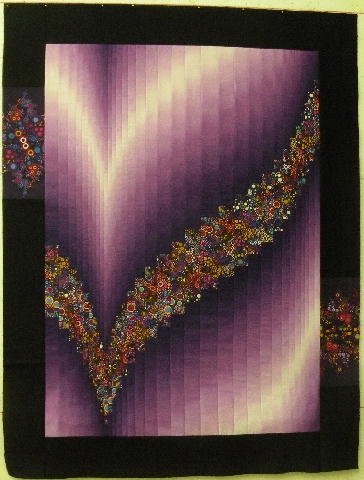
Joy Press’s Two-Fabric Bargello pattern, designed by Susie Weaver, costs $10. The full kit is $50 with 2 yards of gradation fabric, 1 yard of Effervescence and 1 yard of Kona. It makes a Swirl at 33 × 53 inches, a Check Mark at 40 × 55 inches or a Lightning Bolt at 46 × 57 inches. Those wall and lap sizes are easy to quilt on a home machine.
The skills are ones every quilter needs: straight strips, accurate seams and careful pressing. Our free mini wave Bargello is a good warm-up before the full kit.
What size should a first quilt be?
A baby, lap or throw quilt is the best first size. It is quick to piece and easy to quilt on a home sewing machine.
| Size | Typical dimensions | Good first quilt? |
|---|---|---|
| Baby | About 36 × 45 in. | Yes, fastest |
| Lap or throw | About 50 × 65 in. | Yes, most useful |
| Twin | About 70 × 90 in. | Possible, takes longer |
| Queen or king | 90 in. or more | Wait for your second or third quilt |
Typical sizes vary by pattern; check your pattern’s finished size.
Our quilting fabric calculator turns any size into yardage.
Tools you need for your first pattern
You need a rotary cutter, a self-healing mat, a long ruler, a sewing machine with a quarter-inch foot, pins or clips, and an iron.
Our beginning quilting supplies guide lists every tool, and our best quilting rulers guide helps you pick a ruler.
Tips for finishing your first quilt
Most first quilts stall at cutting or quilting. Cut everything before you sew, press as you go, and choose simple quilting.
- Read the whole pattern before cutting.
- Cut everything first and label the pieces.
- Test your quarter-inch seam on scraps.
- Press after every seam.
- Quilt simply: straight lines or an allover pattern.
For the full process from cutting to binding, follow our guide to how to make a quilt for a beginner.
What to do next
Pick one of the first five patterns if you have never quilted, or the Two-Fabric Bargello if you want a striking first quilt with only straight seams. Choose a baby, lap or throw size, gather your tools, and test your quarter-inch seam before cutting into good fabric. Order Joy Press’s Two-Fabric Bargello quilt kit for $50 with free US shipping, or start with the step-by-step how to make a quilt for a beginner guide. See more in our learn to quilt section.
Beginner quilt pattern questions
What is the easiest quilt pattern for a beginner?
A Simple Squares quilt: rows of same-size squares joined with straight quarter-inch seams.
Is a Bargello quilt good for beginners?
A Two-Fabric Bargello is. It uses only straight seams and strips, and the gradation fabric does the color work.
What size should my first quilt be?
A baby, lap or throw size. It is quick to piece and easy to quilt at home.
How many fabrics should a beginner quilt use?
Two to six. Fewer fabrics mean fewer decisions.
Do I need a pattern for my first quilt?
A pattern with a cutting chart and diagrams makes a first quilt much easier.