
By Shariful Alam Pavel · Updated 27 November 2026
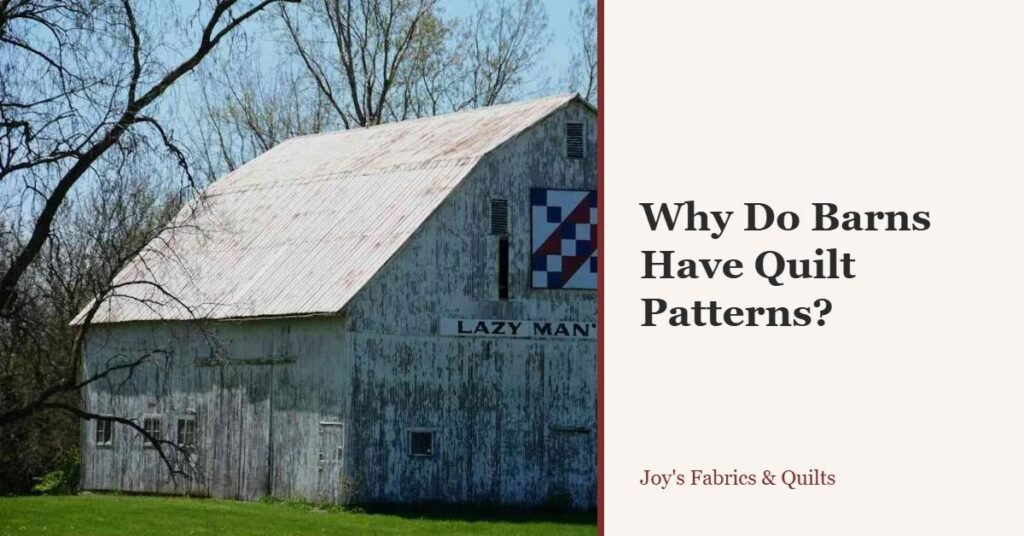
You drive a country road and see it: a bright star or pinwheel on the side of an old barn. Is it a secret sign? An Underground Railroad code? An Amish custom? A hex sign? Barns have quilt patterns because of a public art movement that began in Adams County, Ohio, in 2001. Donna Sue Groves set out to honor her quilting mother, and neighbors turned the idea into a driving trail. Most barn quilts copy traditional quilt blocks, and many honor a family quilt or a family story. This guide explains where barn quilts came from, how the trails spread, and which popular stories about them are myths.
Key facts
- The first official quilt trail began in 2001 in Adams County, Ohio, according to Wikipedia’s quilt trail entry and Ohio Magazine.
- The first barn quilt of the movement was an Ohio Star, unveiled at the Lewis Mountain Herbs fair, according to Ohio Magazine.
- The Adams County trail had 20 quilt squares, according to Southeast Ohio Magazine.
- Barn quilts can now be found in 48 states and Canada, according to the publisher of Suzi Parron’s Following the Barn Quilt Trail.
- A barn quilt is usually painted on plywood, often 8 by 8 feet, according to Suzi Parron.
What is a barn quilt?
A barn quilt is a single quilt block painted on a wooden board and hung on a barn, shed or house. It is not fabric. The design almost always comes from a traditional quilt block.
Barn quilts are painted folk art. Most are exterior plywood or MDO board, primed and painted with exterior paint. Sizes range from small porch boards to 8 by 8-foot squares on barn gables. Suzi Parron, author of two books on the movement, describes the typical barn quilt as an 8 by 8-foot plywood board.
The pattern is the link to quilting. An Ohio Star, Churn Dash or Log Cabin on a barn is the same block a quilter pieces in fabric, scaled up and painted flat.

How did barn quilts start?
Barn quilts started in Adams County, Ohio. Donna Sue Groves wanted to honor her mother, Maxine, a quilter, with a quilt square on their barn. Her neighbors turned that wish into a county trail in 2001.
Donna Sue and her mother bought a farm in Adams County in 1989, according to the Portland Press Herald. The plain tobacco barn on the property bothered Donna Sue. She promised her mother she would paint a quilt square on it.
The idea grew into a community project. Residents met in January 2001 to plan a trail, according to Donna Sue Groves in a 2008 Quilt Alliance interview. They chose 20 quilt squares to form a driving trail, which Southeast Ohio Magazine calls the Clothesline of Quilts.
The first square was not on the Groves barn. It was an Ohio Star, unveiled during the Lewis Mountain Olde Thyme Herb Fair in 2001, according to Ohio Magazine. Maxine Groves got her own square, a Snail’s Trail, in 2003. Donna Sue worked for the Ohio Arts Council, according to Mental Floss, and she helped other counties start trails.
How barn quilt trails spread
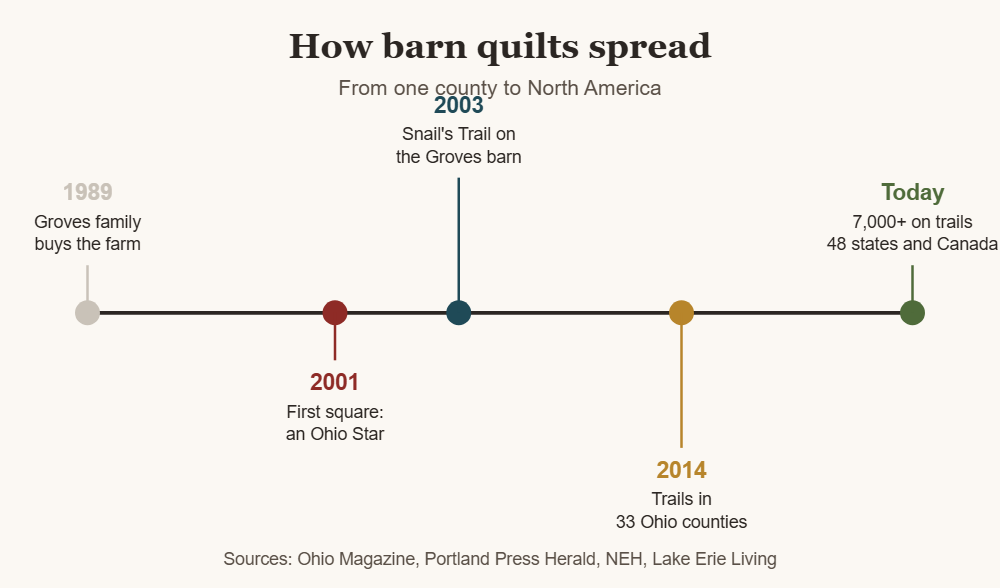
Barn quilt trails spread county by county from Ohio after 2001. Each trail is a mapped route of painted quilt squares that visitors can drive. Barn quilts are now in almost every state and in Canada.
| Year or count | What happened | Source |
|---|---|---|
| 1989 | Donna Sue and Maxine Groves buy their Adams County farm | Portland Press Herald |
| 2001 | Adams County plans and opens the first trail; the first square is an Ohio Star | Ohio Magazine |
| 2003 | Maxine Groves’s barn gets its Snail’s Trail square | Ohio Magazine; Alamance County Parks |
| 2014 | Quilt barn trails are found in 33 Ohio counties | National Endowment for the Humanities |
| Today | Barn quilts in 48 states and Canada | Publisher of Following the Barn Quilt Trail |
| Today | More than 7,000 barn quilts on organized trails | barnquiltinfo.com, as cited by Lake Erie Living |
From one county’s 20 squares to thousands across North America in about two decades.
The National Endowment for the Humanities reported in 2014 that quilt barn trails could be found in 33 Ohio counties. Kentucky has more than 800 barn quilts, according to Lake Erie Living. Trails work as rural tourism: they bring drivers through small towns that most maps skip.
Why barn owners choose quilt patterns
Barn owners choose quilt patterns to honor a family quilter, to mark a farm’s history, to join a county trail, or simply to brighten an old building. The pattern usually carries a personal story.
Many barn quilts copy a quilt that belongs to the family. The Christian Science Monitor reported that some squares reproduce quilts handed down in the barn owner’s family for generations. Others choose a block for its name: a Farmer’s Daughter, a Corn and Beans, a Star for a family member who served.
Trail committees often pair a pattern with a place. The Adams County Travel and Visitors Bureau says each barn on the original trail carries a different pattern honoring the county’s heritage, according to Southeast Ohio Magazine. Our guide to barn quilt meanings explains what common blocks are said to symbolize.
Barn quilt myths and what is true
Barn quilts are often tied to Underground Railroad codes, Amish custom and Pennsylvania Dutch hex signs. None of these explains the modern barn quilt, which dates from 2001.
| Claim | What the record shows |
|---|---|
| Barn quilts are an old pioneer tradition | The organized movement began in 2001, according to Wikipedia and Ohio Magazine. Painted barn decoration is older, but quilt-square trails are new. |
| Barn quilts were Underground Railroad signals | Barn quilts date from 2001. Historians dispute the quilt code story itself, according to the International Quilt Museum. |
| Barn quilts are Amish | The movement started with Donna Sue Groves’s family in Appalachian Ohio, not with the Amish. |
| Barn quilts are hex signs | Hex signs are a separate, older Pennsylvania Dutch folk art. Barn quilts copy quilt blocks. |
| Every pattern has a fixed meaning | Meanings are popular tradition. Owners choose patterns for their own reasons. |
Barn quilts are young folk art built on an old craft, not a coded system.
The Underground Railroad quilt code is a popular story. It gained wide attention with the 1999 book Hidden in Plain View, according to Dickinson College’s House Divided project. Quilt historians consider it a folk story from one family, because no other historical evidence supports it, according to the International Quilt Museum. Even if the code were real, it concerns fabric quilts before the Civil War, not painted squares on barns since 2001.
Other names for barn quilts
A barn quilt is also called a quilt square, barn square, quilt block or painted quilt block. Ohio’s original program used “quilt barn” for the barn and “quilt square” for the painting.
| Name | Where you hear it |
|---|---|
| Barn quilt | Most common name today |
| Quilt square or barn square | Trail maps and local news |
| Quilt barn | Ohio trails; the Ohio Arts Council’s 2008 study is titled “Quilt Barn Impact Study” |
| Painted quilt block | Makers and art centers |
| Quilt trail | The route that links many barn quilts |
Names as used in Ohio Arts Council, Ohio University and trail sources shown in US results, 28 November 2026.
Do barn quilts help people find a farm?
Yes, in a practical way. A big, bold square makes a farm easy to describe: “turn at the barn with the blue star.” The Clark County Public Library in Ohio traces this idea back to the painted barn designs of early European settlers.
Trails build on the same idea. Each square is numbered on a map, so drivers can find their way from one farm to the next.
The Revolutionary War and Civil War stories
Some websites say barn quilts signaled safe houses in the Revolutionary War or guided people on the Underground Railroad. These stories turn up in Google’s top results, so they are worth answering directly.
- The Revolutionary War claim. A Southwestern Indiana Master Gardener Association post says barn quilts showed American forces that an area was safe. It gives no source, and painted barn quilts as a practice date from 2001.
- The Underground Railroad claim. Covered in the myths section above. The quilt code story became widely known through the 1999 book Hidden in Plain View, and historians dispute it.
Neither story is supported by a dated record of painted quilt blocks on barns before the modern movement.
Why quilt patterns work on barns
Quilt patterns work on barns because they are bold, geometric and built from straight lines. A pieced quilt block scales up cleanly, reads from the road and can be painted with tape and a grid.
Traditional quilt blocks are drawn on simple grids of squares and triangles. Painted large, those shapes stay sharp from a distance. That is why stars and classic blocks dominate trails, while curved designs are rare. Our guide to barn quilt patterns gives the grids for the most popular blocks.
The quilt behind the barn quilt
Every barn quilt points back to a fabric quilt. The movement began as a daughter’s tribute to her mother’s quilting, and the same blocks have been pieced in fabric for generations.
Quilting in America is far older than barn quilts. Our history of quilting guide traces the blocks on today’s barns back to the quilts that first carried them.
What to do next
If you want a barn quilt with meaning, start with the story: a family quilt, a person to honor or your farm’s history. Then pick a block that fits it and a size that suits your building. To find what a pattern is said to mean, read our barn quilt meanings guide. To paint your own, follow how to make a barn quilt. To have one painted by hand in Godley, Texas, see barn quilts for sale or call Joy Press at 817-223-8736.
Barn quilt history questions
Why do people put quilt squares on barns?
To honor a family quilter, mark a farm’s history, join a county trail or brighten a building. The modern movement began in 2001 as Donna Sue Groves’s tribute to her mother.
Who started barn quilts?
Donna Sue Groves of Adams County, Ohio, with her neighbors, in 2001. She wanted to honor her mother, Maxine, a quilter.
What was the first barn quilt?
An Ohio Star, unveiled during the Lewis Mountain Olde Thyme Herb Fair in Adams County, Ohio, in 2001, according to Ohio Magazine.
Are barn quilts related to the Underground Railroad?
No. Barn quilts date from 2001. The Underground Railroad quilt code is a story about fabric quilts, and historians dispute it.
How many barn quilts are there?
More than 7,000 on organized trails, according to barnquiltinfo.com as cited by Lake Erie Living, across 48 states and Canada.