
By Shariful Alam Pavel · Updated 28 November 2026
A fabric panel is the fastest way to a quilt that looks finished. The picture is already printed, so you spend your time on borders, quilting and binding instead of hundreds of seams. A quilting fabric panel is a large printed picture on quilting cotton, usually the full width of the fabric, about 44 inches, by 24 or 36 inches long. You trim it square, add borders until it reaches the size you want, then quilt and bind it. This guide covers panel sizes, prices, border math, color choices, squaring a crooked panel and how to buy from a seller you can trust.
Key facts
- One side of most panels is the full width of the bolt, most often 44 inches, according to QUILTsocial.
- Most panels range from 23 to 26 inches by 42 to 44 inches, though some reach 35 inches, according to QUILTsocial.
- A 24 × 44-inch panel suits baby quilts, wall hangings and table runners; a 36 × 44-inch yard panel suits lap and crib quilts, according to HC Quilts.
- Utah State University Extension uses a 21 1/2 × 30 3/4-inch panel for a wall hanging pattern with two borders and prairie points.
- Measure a panel in three places and average them before cutting borders, according to Utah State University Extension.
- On 28 November 2026, Google Shopping listed most standard panels at about $5 to $16 each.
What is a quilting fabric panel?
A panel is a single printed scene or design on quilting cotton, sold as one piece rather than by the yard. It becomes the center of a quilt.
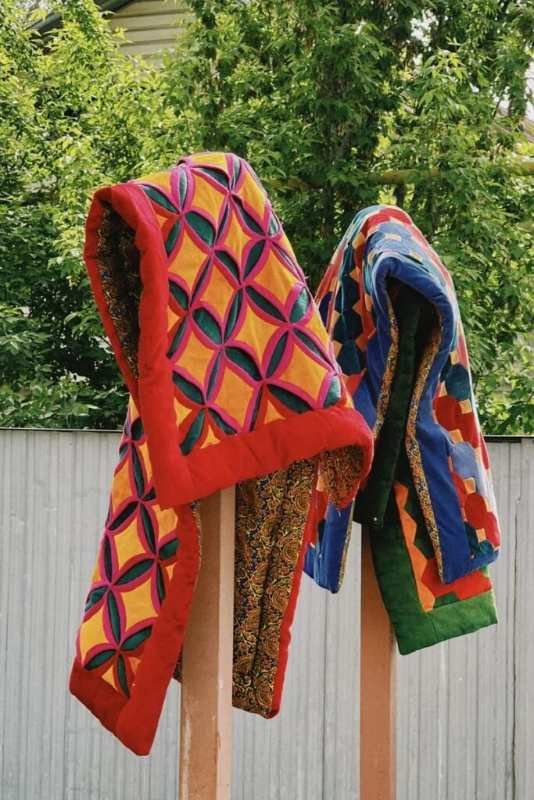
HC Quilts describes a panel as a central medallion: it gives you the main picture, and your borders and quilting finish the story. Panels are popular for baby quilts, holiday wall hangings and gifts because the hard design work is done.
| Panel type | What it looks like | Typical use |
|---|---|---|
| Scenic panel | One large picture | Wall hangings, lap quilts |
| Block panel | Several printed squares | Cut apart and add sashing |
| Cheater panel | Printed to look pieced | Quick quilt tops, backs |
| Runner panel | Long and narrow | Table runners |
| Small blocks | About 12 × 12 in. | Pillows, totes, placemats |
Panel types you will see in shops.
What size are quilt panels?
Most panels are about 24 × 44 or 36 × 44 inches. The 44-inch side is the width of the fabric bolt.
| Panel size (approx.) | Best for | Source |
|---|---|---|
| 12 × 12 in. | Pillows, totes, placemats | HC Quilts |
| 24 × 44 in. (standard) | Baby quilts, wall hangings, runners | HC Quilts |
| 36 × 44 in. (yard panel) | Lap quilts, crib quilts, quilt backs | HC Quilts |
| 25 × 45 in. | Runner or narrow display quilt | Linda’s Electric Quilters |
| 35 1/4 × 42 3/4 in. | Lap or presentation quilt center | Linda’s Electric Quilters |
Printed sizes vary; always measure your own panel.
How much do quilting fabric panels cost?
A standard 24 × 44-inch panel usually costs about $6 to $12. Large yard panels and designer prints run higher.
| Panel | Price seen | Size |
|---|---|---|
| Blank Quilting Ocean Oasis coastal panel | About $7 to $8 | 24 × 44 in. |
| Fable and Fern block panel | About $9 | 24 × 44 in. |
| Robert Kaufman Venice Jewel floral panel | About $10 | 24 × 44 in. |
| Northcott Serenity Springs panel | About $10 to $15 | 36 × 43 in. |
| Timeless Treasures Wild Beauty peacock panel | About $9 to $14 | 24 × 43 in. |
Prices listed on Google Shopping on 28 November 2026. Panels sell out fast, so prices and stock change.
Budget for more than the panel. Borders, binding, backing and batting usually cost more than the panel itself.
Where can you buy quilting fabric panels?
Quilt shops, online quilt shops, big-box craft stores and Etsy all sell panels. Look for the fabric maker’s name on the listing.
The makers you will see most are Northcott, Timeless Treasures, Robert Kaufman, Blank Quilting, Hoffman, Moda, P&B Textiles and Windham. My Favorite Quilt Store lists panels from Moda, Cotton + Steel, P&B Textiles and Windham Fabrics. Hancock’s of Paducah notes that panels are sold by the unit and most are 100% cotton.
How do you know a panel seller is legitimate?
Check for a named fabric maker, a real return policy and photos of the actual panel. Those three cover most risks when buying online.
People ask Google this question often enough that it appears in “People also ask” for this search. Here is a checklist that works for any shop:
- A named maker and collection. Real panels come from a mill or brand. The name is printed on the selvage.
- Exact size in inches. Vague listings like “large panel” are a warning sign.
- Fiber content. Look for 100% cotton quilting weight.
- A clear return policy and a real contact address.
- Reviews off the shop’s own site. Look for reviews on Google, Facebook groups or quilting forums.
- A believable price. Licensed designer panels rarely sell far below about $5.
- Payment protection. A credit card or PayPal gives you a route to dispute a bad order.
Our own checklist; it is not a judgment on any named store.
How wide should borders be on a panel quilt?
Decide your finished size, subtract the trimmed panel size, and divide by two. That is the total border width for each side. Our quilt border calculator does the math and the yardage for you.
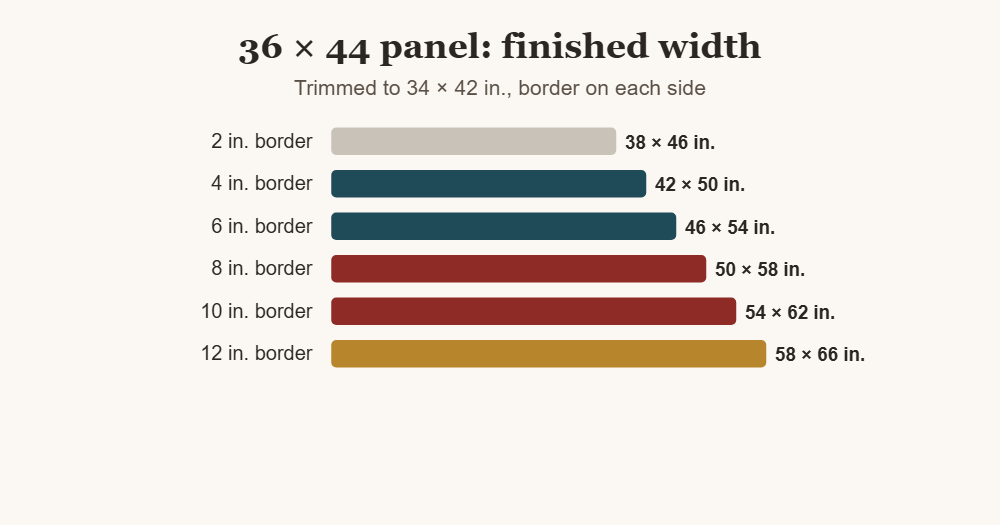
Here is what border widths do to two common panels. We assume a 36 × 44-inch panel trims to 34 × 42 inches, and a 24 × 44 panel trims to 23 × 42 inches.
| Total border each side | 36 × 44 panel (34 × 42 trimmed) | 24 × 44 panel (23 × 42 trimmed) |
|---|---|---|
| 2 in. | 38 × 46 in. (wall) | 27 × 46 in. (wall or runner) |
| 4 in. | 42 × 50 in. (crib) | 31 × 50 in. (wall) |
| 6 in. | 46 × 54 in. (baby or lap) | 35 × 54 in. (baby) |
| 8 in. | 50 × 58 in. (lap) | 39 × 58 in. (baby) |
| 10 in. | 54 × 62 in. (throw) | 43 × 62 in. (crib or lap) |
| 12 in. | 58 × 66 in. (throw) | 47 × 66 in. (lap) |
Finished size = trimmed panel + 2 × border. Our own arithmetic; your trim will vary.
A border of 8 to 12 inches can be one wide strip or two or three narrower strips. QUILTsocial suggests making each border noticeably wider or narrower than the one beside it, not the same size, for better visual appeal.
How do you make a quilt from a panel?
Trim and square the panel, add borders one round at a time, then layer, quilt and bind. Utah State University Extension says its panel wall hanging can be pieced in an afternoon.
- Press the panel flat without steam stretching it.
- Find the printed edge. Many panels have a printed frame line; trim a quarter inch outside it.
- Square it. Measure width and length in three places each and average them, as Utah State University Extension advises.
- Cut side borders to the averaged length. Sew them on first.
- Measure again through the middle and cut top and bottom borders.
- Repeat for each extra border round.
- Layer and quilt. Outline the main shapes in the panel to make them pop.
- Bind. Our quilt binding calculator gives you strips and yardage.
Utah State University Extension notes that cross-grain borders have a little give and may need piecing, while lengthwise-grain borders do not stretch but use more fabric.
How do you fix a panel that was printed crooked?
Follow the printed design, not the fabric grain. A panel is only useful if the picture sits straight.
- Line your ruler up with the printed frame or a straight line in the picture.
- Trim to the print, even if that cuts across the grain slightly.
- Stay-stitch the edges if the trim is off-grain, to stop stretching.
- Add a narrow first border to give you room to square up again.
- Ease, don’t stretch. Utah State University Extension suggests putting the fuller side next to the feed dogs to ease in fullness without tucks.
- Block it first. For a badly skewed panel, Fabric Cafe’s tutorial shows lightly misting it with water. Smooth it square on a grid mat and let it dry before trimming.
Linda’s Electric Quilters warns that every crooked edge on a panel shows up later in the borders and quilting lines.
Border ideas for panel quilts
Plain borders keep the panel the star. Pieced borders turn a panel into a quilt that looks fully designed.
| Border style | Look | Skill |
|---|---|---|
| Plain or tone-on-tone | Quiet frame | Beginner |
| Two narrow + one wide | Classic picture frame | Beginner |
| Rail fence or brick | Movement around the edge | Confident beginner |
| Pinwheels or stars at corners | Fully designed quilt | Intermediate |
| Ombre or gradation fabric | Glowing, shaded frame | Beginner |
| Fussy-cut blocks | Matches the panel’s theme | Intermediate |
Missouri Star’s tutorial shows rail fence, brick and pinwheel borders on a panel.
How do you choose border colors for a panel? The 60/30/10 rule
Pull every border color from the panel itself. The 60/30/10 rule, borrowed from interior design, is a simple way to balance them.
| Share | Role | Where it goes on a panel quilt |
|---|---|---|
| 60% | Main color | The panel background and the widest border |
| 30% | Secondary color | A middle border or the binding |
| 10% | Accent | A narrow inner border, about 1 inch finished |
The 60/30/10 split as quilters apply it. A starting point, not a law.
A narrow accent border in the panel’s brightest small color makes the picture look framed. Fabric Cafe’s tutorial suggests pulling a background shade from the panel’s edge and an accent from its main artwork. For more on value and contrast, see our guide to color theory for quilters.
A gradation fabric makes a striking panel frame because the color shades on its own. Read how it works in our gradation fabrics guide. Joy Press sells Maywood Studio Gelato ombre, which retailers list at about 43 to 45 inches wide with the color running across the width. See the colorways on our Maywood Studio Gelato ombre fabric page.
How to choose a good quilting panel
Pick a panel printed on real quilting cotton, square on the fabric, in a size that matches the quilt you want.
- Check the cotton. The same rules apply as for any fabric; see our guide to 100% cotton quilting fabric.
- Check the print alignment on the bolt before it is cut.
- Buy matching yardage for borders and binding from the same collection.
- Buy two panels if you want to cut one up for blocks or use one on the back.
- Plan the back now. Use our quilt backing guide for yardage.
Batting matters too. A low-loft cotton batting keeps a wall-hanging panel flat.
What to do next
Measure your panel, decide your finished size, and use the border table to set your border widths. Trim to the printed design, average your measurements before cutting borders, and add one round at a time. Then quilt around the main shapes and bind. For a shaded frame that looks custom, pair your panel with Joy Press’s Maywood Studio Gelato ombre fabric, or try her Two-Fabric Bargello quilt kit for $50. See more in our quilting fabric by the yard guide.
Quilting fabric panel questions
What size is a standard quilt panel?
Most are about 24 × 44 or 36 × 44 inches; the 44-inch side is the bolt width.
How do I make a panel bigger for a quilt?
Add borders. Finished size equals the trimmed panel plus twice the border width.
What can I make with a 36 × 44-inch panel?
A crib, baby or lap quilt, or a throw with borders of 10 to 12 inches.
How do I square up a crooked panel?
Trim to the printed design, not the grain, and stay-stitch any off-grain edges.
Do I need to quilt a fabric panel?
Yes, if you want a quilt. Outline the main shapes so the picture stands out.
How much does a quilt panel cost?
Most standard panels cost about $5 to $16 each; borders and backing add more.