

By Shariful Alam Pavel · Updated 27 November 2026
You finished a quilt you are proud of, or bought one, and you want it on the wall, not in a closet. But a quilt hung from two corners sags and stretches. What is the right way to display a quilt? The safest way to hang a quilt is to support its whole top edge. Use a sewn 4-inch sleeve on a rod, a clamp hanger the full width of the quilt, or a ladder or rack for folded display. This guide compares quilt hangers and racks based on our research and gives tips to keep a hung quilt flat and safe. We have not tested these products; facts come from retailers and quilting guides.
Key facts
- Quilt shows require a hanging sleeve, usually 4 inches wide, according to a Yahoo Lifestyle article and AppleGreen Cottage.
- For a 4-inch finished sleeve, cut a strip 8 1/2 inches wide by the quilt’s width minus about an inch, according to Missouri Star.
- Missouri Star lists wooden wall hanging clips at $13.95 and 12-inch dowel quilt hangers at $9.45.
- Quilt hanger types include wall-mounted racks, floor and wall stands, clips, fans and arm hangers, according to Missouri Star.
- Missouri Star advises against pinning a quilt to a wall, especially a fragile antique quilt.
Ways to hang or display a quilt
Choose by the quilt’s size, weight and how long it will stay up. Sleeves and rods suit large quilts; clamp hangers suit wall quilts; ladders and racks suit folded display.
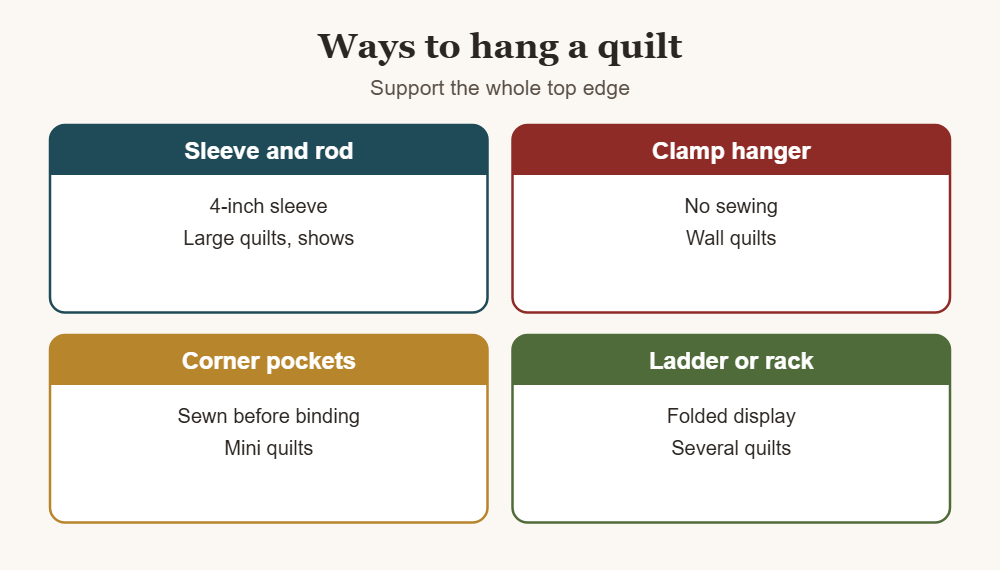
| Method | Best for | Sewing needed | Notes |
|---|---|---|---|
| Hanging sleeve and rod | Large wall quilts to full size | Yes | The method quilt shows use |
| Clamp or clip hanger | Small to medium wall quilts | No | Supports the full top edge |
| Corner pockets | Small wall quilts | Yes, before binding | A dowel slips into two triangles |
| Fabric tabs or rings | Small art quilts | Yes | Light quilts only |
| Quilt ladder | Folded quilts | No | Shows several quilts at once |
| Floor or wall rack | Folded bed quilts | No | Easy to change |
Missouri Star notes that sleeves are for big quilts, anything from a large wall hanging up to a full-size quilt.
How to make a hanging sleeve
A hanging sleeve is a fabric tube sewn across the back of the quilt near the top. A rod slides through it and rests on brackets.
Missouri Star’s method for a 4-inch finished sleeve:
- Cut a strip 8 1/2 inches wide by the quilt’s width minus about 1 inch.
- Hem both short ends.
- Fold in half lengthwise, right sides out, and press.
- Sew the raw edges into the top binding, or hand-stitch the sleeve to the back.
- Leave a little slack in the sleeve so the rod does not push the quilt top out, as Create Whimsy recommends.
Hand-stitch through the backing only so no stitches show on the front. Create Whimsy makes her sleeves 5 inches wide, noting most shows require 4 or 5 inches.
Quilt hangers: clips and clamps
A clamp hanger grips the top edge of the quilt between two strips of wood. It needs no sewing, and the quilt comes down easily.
Size the hanger to the quilt, not the wall, so the whole top edge is supported, Missouri Star advises. Clips that hold only a few points can let a heavy quilt sag between them.
| Hanger | Listed price at Missouri Star | Good for |
|---|---|---|
| Wall hanging clips (wood) | $13.95 | Wall quilts without a sleeve |
| 12-inch dowel hanger | $9.45 | Small wall hangings |
Missouri Star prices as listed in 2026.
Quilt ladders and racks
A quilt ladder or rack shows folded quilts without hanging them. It is the easiest way to display several quilts and change them often.
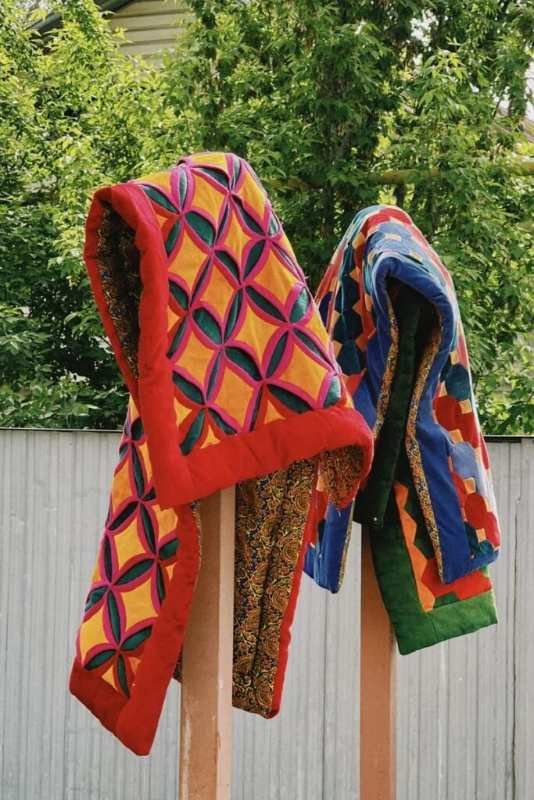
House Digest calls the quilt ladder one of the most popular ways to display quilts. A ladder shows the prettiest folds and lets you swap quilts with the seasons.
Quilt hanger types and prices in 2026
Quilt hangers cost about $12 to over $200. Small clip hangers start near $12; adjustable rods run about $35 to $45; solid hardwood clamp hangers cost $120 to $230.
Team Joy’s Fabrics reviews and researches these products; we have not tested them.
| Type | Example | Size | Price seen |
|---|---|---|---|
| Small wood clip hangers | Dritz Quilt Hangers (2-pack) | For quilts up to ¼ in. thick | About $12 |
| Wall hanging clips | Missouri Star Wall Hanging Clips | Small wall quilts | About $8 to $14 |
| Adjustable rod for a sleeve | Hang It Dang It | 21 in. to 110 in. across three sizes | About $35 to $45 |
| Oak clamping bar | Quilt Hangers (Utah) | 6 in. to 95 in. wide, six stains | About $35 to $175 |
| Magnetic wall strips | SewTites Quik Hang | Four 16½ in. strips, six magnets | About $80 to $88 |
| Hardwood clamp hanger | Amish oak, DutchCrafters; Rustic Red Door | Larger display widths | About $119 to $229 |
| Closet hangers | Stock Your Home stainless steel (3-pack) | Rated up to 40 lb each | About $27 |
| Floor rack | Winsome Eleanor Quilt Rack | Six rungs | About $37 |
Prices and specs from Google Shopping and Google’s AI summary for “quilt hangers”, United States, 28 November 2026.
Clamp and clip hangers need no sewing. A rod or magnetic system works best with a hanging sleeve on the back of the quilt.
Magnetic quilt hangers
Magnetic hangers use thin metal strips on the wall and magnets that hold the quilt against them. They make it fast to swap seasonal quilts.
Two styles turn up in US results. SewTites Quik Hang uses strips on the wall and magnets on the front edge. Magnificent Quilting Company’s invisible hangers pair magnets with a rod pocket so nothing shows. Check the magnet strength against your quilt’s weight before you hang a heavy bed quilt.
How to make your own quilt hanger
You can make a simple quilt hanger from a wooden lath or dowel and a hanging sleeve. Cut the wood about an inch shorter than the quilt’s width so the ends do not show.
- Sleeve and dowel. Sew a sleeve on the back, slide in a dowel or curtain rod, and rest it on two nails or brackets.
- Clamping bar. Sandwich the top edge between two thin boards held with screws or bolts at each end. Do not drill through the quilt.
- Seal the wood. Raw wood gives off acids. Paint or seal it, or keep a strip of washed cotton muslin between the wood and the quilt.
Avoid nails, pins and tacks through the quilt itself. They tear fibers and leave holes.
How to store quilts when they are not on display
Store quilts rolled or loosely folded in breathable cotton or acid-free materials, not plastic. University of Nebraska–Lincoln Extension recommends lining shelves and boxes with acid-free tissue or washed unbleached cotton muslin.
| Method | Best for | Note |
|---|---|---|
| Rolled on a covered tube | Heirlooms and show quilts | No fold lines; cover the tube with muslin or acid-free tissue |
| Folded in an acid-free box | Most quilts | Pad folds with crumpled acid-free tissue |
| Cotton pillowcase or bag | Quilts in regular use | Breathable; refold now and then |
| Flat on a spare bed | Several quilts | Cotton sheets between quilts |
Methods from University of Nebraska–Lincoln Extension, the Canadian Conservation Institute and Missouri Star Quilt Co. guidance.
Avoid attics, basements and plastic bags, which trap moisture. If you use a cedar chest, line it first; Missouri Star advises against mothballs.
Tips to keep a hung quilt safe
Keep hung quilts out of direct sun, away from heat, and rest them now and then. A little care keeps colors bright and fabric strong.
- Avoid direct sun, which fades cotton over time.
- Avoid heat vents and fireplaces.
- Never use pins or nails through the quilt.
- Rest the quilt: one home guide suggests taking it down for a couple of weeks every six months.
- Remove dust gently; Home Grail lists vacuuming among its quilt care tips.
Hanging Bargello and wall quilts
Bargello and gradation wall quilts look best perfectly flat, so the color waves read cleanly. A full-width sleeve and a rod give the most even support.
Joy Press’s Two-Fabric Bargello quilts are wall and lap sizes, from 34 × 55 to 61 × 67 inches. A 4-inch sleeve and a rod suit all of them. See Bargello quilts for the designs, and our guide to how to wash a quilt for care between displays.
Which quilt hanger should you choose?
Match the method to the quilt: sleeve and rod for large quilts, clamps for small wall quilts, a ladder for folded display.
| Your quilt | Best display |
|---|---|
| Large wall quilt or bed quilt on a wall | Sleeve and rod |
| Small or medium wall quilt | Full-width clamp hanger |
| Mini quilt | Corner pockets and a small dowel |
| Several bed quilts | Ladder or floor rack |
| Antique or fragile quilt | Sleeve and rod, out of light, and rest it often |
Our research-based suggestions, not tested picks.
Related guides: to hang a quilt you have just finished, see how to bind a quilt first. For the batting that helps a quilt hang flat, see cotton quilt batting.
What to do next
Measure your quilt’s width, then choose a full-width method: a 4-inch sleeve and rod for large quilts, or a clamp hanger for wall quilts. Hang it away from direct sun and heat, and rest it every few months. For a quilt worth hanging, see Joy Press’s handmade quilts for sale and Bargello quilts, and browse the rest of our quilting supplies guide.
Quilt hanger questions
What is the best way to hang a quilt?
A 4-inch hanging sleeve with a rod, which supports the full top edge.
How do I hang a quilt without a sleeve?
Use a full-width clamp hanger, corner pockets, or a quilt ladder for folded display.
How wide should a quilt sleeve be?
4 inches finished is the common show standard; some quilters make 5-inch sleeves.
Can I hang a quilt with pins or nails?
No. Pins and nails can tear and stain fabric; Missouri Star advises against pinning quilts.
Has Joy’s Fabrics tested these hangers?
No. This guide is based on our research of retailer and quilting-guide information.