

By Shariful Alam Pavel · Updated 27 November 2026
Batting is the layer nobody sees and everybody feels. Pick the wrong one and a quilt turns stiff, bunches after washing or shows the quilting lines poorly. Cotton batting is the classic choice, but even within “cotton” there are big differences: scrim or no scrim, how far apart you can quilt, how much it shrinks. The best cotton batting for most quilters is a low-loft, needle-punched cotton that allows the quilting distance your design needs and shrinks a little for a soft, crinkled finish. This guide compares popular cotton battings based on our research, explains loft, scrim and quilting distance, and helps you choose. We have not tested these battings ourselves; facts come from manufacturer and retailer information.
Key facts
- Warm & Natural is needle-punched through a scrim and can be quilted up to 10 inches apart, according to Linda’s Electric Quilters and The Warm Company’s guidance.
- Quilters Dream Select Cotton is 100% cotton with no scrim and can be quilted up to 8 inches apart. It shrinks about 5% on first wash, according to Linda’s Electric Quilters.
- Hobbs Heirloom 80/20 allows about 4 inches between quilting lines, according to Linda’s Electric Quilters.
- Cotton and wool battings shrink about 3% to 5% when washed, according to Omni Calculator’s batting guide.
- Some sources describe scrim cotton battings such as Warm & Natural as about 87% cotton with a polymer scrim.
What makes a good cotton batting?
A good cotton batting lies flat, needles easily, holds together for the quilting distance you plan, and washes into a soft, slightly crinkled quilt. Loft, scrim and quilting distance decide how it behaves.
| Term | What it means | Why it matters |
|---|---|---|
| Loft | Thickness | Low loft is flat and traditional; high loft is puffy |
| Scrim | A thin stabilizing web the fibers are needled through | Lets you quilt farther apart |
| Quilting distance | The maximum space between quilting lines | Sets how dense your quilting must be |
| Shrinkage | Size loss on first wash | Creates the crinkled antique look |
| Needle-punched | Fibers locked together by needles, not glue | Stable without chemical binders |
Quilting distance is the number to check first; it limits your quilting design.
Popular cotton battings compared
Most cotton battings fall into two groups: scrim-stabilized battings that allow wide quilting, and scrim-free battings that are softer and flatter but need closer quilting.
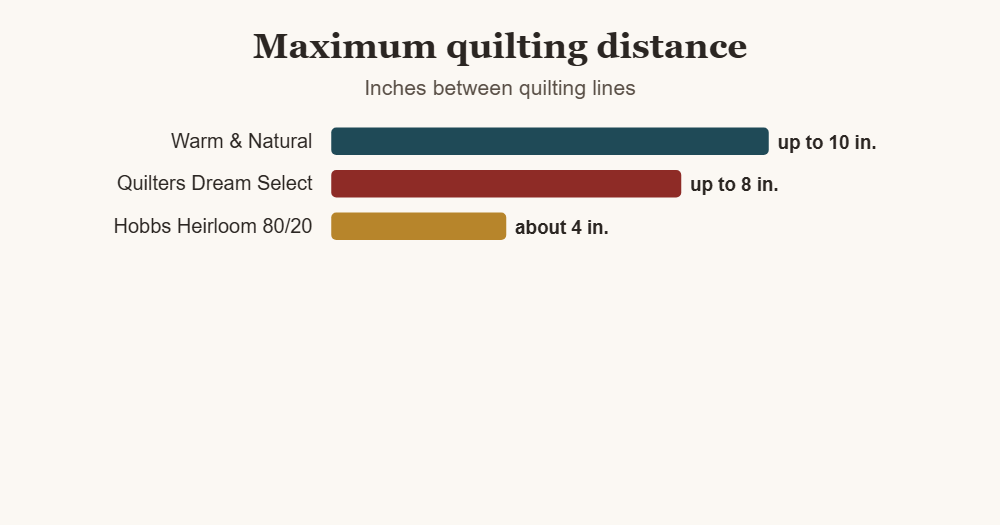
| Batting | Fiber | Scrim | Max quilting distance | Shrinkage |
|---|---|---|---|---|
| Warm & Natural | Cotton, needle-punched | Yes | Up to 10 in. | About 3–5% |
| Quilters Dream Select Cotton | 100% cotton | No | Up to 8 in. | About 5% |
| Hobbs Heirloom 80/20 | 80% cotton, 20% polyester | Needle-punched | About 4 in. | Less than 100% cotton |
| Pellon Natural Cotton | Cotton with scrim | Yes | See package | See package |
From Linda’s Electric Quilters, Missouri Star, Walmart and manufacturer guidance; we have not tested these battings.
WeAllSew notes that Warm & Natural has a scrim, while certain lofts of Quilters Dream Cotton do not. Missouri Star lists Warm & Natural, Quilters Dream and Bosal Katahdin among popular cotton battings.
100% cotton vs 80/20 batting
An 80/20 blend adds 20% polyester for a little more loft and less shrinkage. 100% cotton gives a flatter, more traditional look and more crinkle after washing.
| 100% cotton | 80/20 cotton/poly | |
|---|---|---|
| Look after washing | Flat, crinkled, antique | Soft, slightly puffier |
| Shrinkage | More (about 3–5%) | Less |
| Feel | Breathable, cool | Slightly warmer and lighter |
| Fiber migration on dark fabric | Natural color helps | Can show white fibers |
Missouri Star suggests natural (unbleached) cotton batting to reduce visible fiber migration on dark fabric.
Which cotton batting for which quilt?
Match the batting to how you will quilt and how the quilt will be used. Wide, open quilting needs a scrim batting. Dense custom quilting can use scrim-free cotton.
| Quilt | Batting choice | Why |
|---|---|---|
| Lap or bed quilt with open allover quilting | Warm & Natural | 10-inch quilting distance |
| Show quilt or hand quilting | Quilters Dream Select Cotton | Flat, smooth needling |
| Longarm production quilting | Hobbs Heirloom 80/20 | Stable, soft drape |
| Wall quilt or Bargello hanging | Low-loft cotton | Hangs flat |
| Quilt you want crinkly | 100% cotton, unwashed until finished | Shrinks for the antique look |
Our research-based suggestions, not tested picks.
For Joy Press’s Two-Fabric Bargello wall quilts, a low-loft cotton hangs flat and lets the color waves read cleanly.
Cotton batting prices in 2026
Packaged cotton batting costs about $13 to $50 in the US, depending on size; by the yard it runs about $12 to $19 a yard for 90-inch widths. Full bolts for longarm and production work cost $45 to $185 and up.
Team Joy’s Fabrics reviews and researches these products; we have not tested them.
| Batting | Format | Price seen |
|---|---|---|
| Hobbs Heirloom Premium Cotton | Twin package | About $17 |
| Warm & Natural | Package | About $15 |
| Missouri Star Nature’s Best 100% Cotton | Throw | About $20 on sale |
| Pellon Nature’s Touch 100% Cotton | Package | About $13 to $23 on sale |
| Quilters Dream Cotton Select | Package | About $65 on sale |
| Quilters Dream Deluxe Natural Cotton | King | About $50 on sale |
| Warm 100 Cotton | Queen | About $41 |
| Bosal Katahdin On-A-Roll (organic cotton) | Roll | About $13 to $25 |
| Cozy Cotton 100% Cotton | By the yard, 90 in. wide | About $13 a yard |
| Quilters Dream Natural Select | By the yard, 93 in. wide | About $18 a yard |
| Pellon Natural Cotton with scrim | 96 in. × 9 yard bolt | About $45 |
| Pellon White Cotton | 120 in. × 30 yard bolt | About $184 |
Prices from Google Shopping for “cotton quilt batting”, United States, 28 November 2026. Sale prices change often.
For one quilt, a packaged size is simplest. If you make many quilts, by-the-yard or bolt batting costs less per quilt and wastes less.
What quilters on Reddit actually use
Warm & Natural is the cotton batting named most often in Reddit’s r/quilting threads, with Quilters Dream close behind. Many quilters also say they use an 80/20 blend for most quilts.
- Warm & Natural / Warm & White. Several top answers say they use it exclusively because it works well for them.
- Quilters Dream. Fans praise it as low-shedding and made without scrim or chemicals.
- 80/20 blends. Quilter’s Best Blend and Hobbs 80/20 come up for beginners and longarm work.
- Pellon Nature’s Touch. Named as a no-scrim 100% cotton option.
Summarized from r/quilting threads shown in Google results, 28 November 2026.
Best batting for hand quilting
Cotton can be hand quilted, but it is not the easiest choice. In r/handquilting, the top answer says wool is the easiest to hand quilt, blends included, and to avoid battings with scrim.
If you want cotton and plan to hand quilt, pick a thin, no-scrim cotton such as Quilters Dream Select. A needle passes through it more easily than through a scrim-bonded batting.
Where to buy cotton batting
You can buy cotton batting at quilt shops, big craft stores and online. Hobby Lobby lists Warm & Natural, Warm White Cotton and Hobbs Heirloom Premium Cotton; Michaels and Walmart carry Pellon cotton battings.
For wide widths and bolts, online quilt shops such as Missouri Star, Hancock’s of Paducah and Fat Quarter Shop carry the most sizes.
What can you use instead of cotton batting?
If you cannot get cotton batting, a cotton flannel layer or a thin cotton blanket can stand in for a light summer quilt. Polyester or 80/20 batting is the easiest swap for a full quilt.
These are common substitutes, not tested recommendations. Flannel gives a very flat, light quilt; a blanket can be heavy and hard to quilt through.
Should you prewash cotton batting?
Prewash only if you want to prevent shrinkage. Most quilters skip it because the shrinkage gives a quilt its soft, crinkled finish.
If you want a flat look, follow the maker’s prewash directions; some cotton battings, such as Hobbs 100% cotton, include them on the package, according to a Quilting Board discussion. Never put batting in a washer without checking, as some battings pull apart.
How much batting do you need?
Cut batting larger than the quilt top on every side, and cut it to match the backing. If a longarm quilter will finish the quilt, ask how much extra they need.
Our quilt backing calculator sizes the backing.
Related guides: if you plan to quilt big quilts at home, see longarm quilting machines. To display a finished quilt, see quilt hangers.
What to do next
Decide how far apart you will quilt, then pick a batting that allows it. Allow about 10 inches for Warm & Natural, 8 inches for Quilters Dream Select, 4 inches for Hobbs 80/20. Choose 100% cotton for a flat, crinkled finish or an 80/20 blend for a softer, slightly puffier one. Read our full types of quilt batting guide for wool, bamboo and polyester options, and our quilting supplies guide for the rest of your tools.
Cotton batting questions
What is the best cotton batting for quilts?
It depends on your quilting. Warm & Natural allows quilting up to 10 inches apart; Quilters Dream Select Cotton is scrim-free and flat.
Does cotton batting shrink?
Yes, about 3% to 5% on the first wash, which gives the classic crinkled look.
Is 80/20 batting better than 100% cotton?
Not better, just different. 80/20 is a little puffier and shrinks less; 100% cotton is flatter and crinkles more.
What is scrim in batting?
A thin web the fibers are needled through, which stabilizes the batting and allows wider quilting.
Has Joy’s Fabrics tested these battings?
No. This guide is based on our research of manufacturer and retailer information.