By Shariful Alam Pavel · Updated 28 November 2026
Two bolts can both say “100% cotton” and still sew, wash and wear very differently. One stays crisp, cuts clean and keeps its color for decades. The other frays at the seams and shrinks out of square. 100% cotton quilting fabric is a medium-weight, plain-weave cotton, usually 42 to 45 inches wide, made to be cut small and washed for years. Good quilting cotton has at least 60 threads per inch each way and little shrinkage. This guide shows how to judge it, what it costs, where to buy it, which brands quilters trust and how much to buy.
Key facts
- Good quilting cotton has a thread count of at least 60 threads per inch, lengthwise and crosswise, according to Missouri Star.
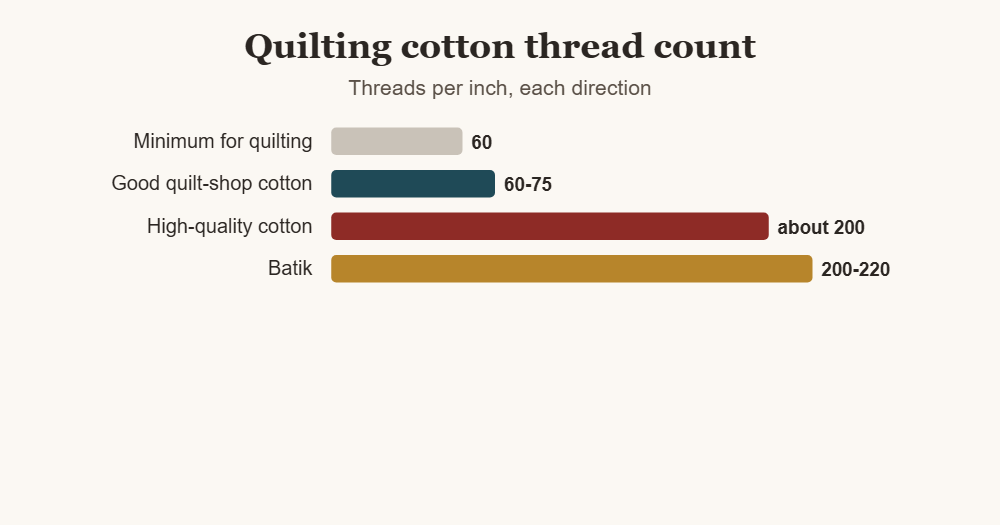
- Quilt cotton runs from about 60 to 75 threads per inch for good quality up to about 200 for high quality, according to The Quilt Show. Batiks use 200 to 220.
- Quilting cotton is usually 42 to 44 inches wide and about 4 to 6 ounces per square yard, according to a textile research summary by Jared Watkins.
- Kona Cotton by Robert Kaufman comes in 365 colors, according to Missouri Star.
- Moda Bella Solids and Kona Cotton both shrink about 2 to 3% before prewashing, according to Linda’s Electric Quilters.
- On 28 November 2026, Google Shopping listed quilting cotton from about $2 to $18 a yard, from budget craft bolts to designer prints.
What is 100% cotton quilting fabric?
It is a plain-weave cotton cloth made for patchwork. Each crosswise thread passes over and under each lengthwise thread, which keeps pieces stable when you cut and sew them.

Missouri Star describes quilting cotton as a medium-weight, stable plain weave made for piecing, while apparel cottons like lawn, voile and chambray are lighter with more drape. That stability is the point. A quilt is hundreds of small pieces held by quarter-inch seams, so the fabric must not stretch, shift or unravel.
| Fabric | Weave and weight | Good for quilt tops? |
|---|---|---|
| Quilting cotton | Plain weave, medium weight | Yes, the standard |
| Batik | Very tight weave, fine thread | Yes, crisp and sharp |
| Apparel lawn or voile | Light, drapey | Not for beginners; shifts |
| Cotton-poly blend | Varies | Avoid in tops; shrinks unevenly |
| Quilter’s muslin | Plain weave, unbleached or bleached | Backgrounds and practice |
| 108-inch wide cotton | Plain weave, extra wide | Quilt backs |
Common fabrics quilters meet in a shop, and where each fits.
Is 100% cotton fabric good for quilting?
Yes. It is the standard fabric for quilt tops, as long as the weave is tight. Cotton presses flat, holds a crisp seam, needles easily by hand or machine and stands up to washing.
Those traits matter more than they sound. A pressed seam that stays put keeps points sharp. A fabric that does not stretch keeps blocks square. Cotton also breathes, so a cotton quilt feels comfortable on a Texas night.
The catch is that “100% cotton” only tells you the fiber. It says nothing about thread count, weight or finish. That is why the next section matters.
Quilting cotton vs regular cotton: what is the difference?
Quilting cotton is a medium-weight, tightly woven, stable plain weave. “Regular” cotton can be anything from sheer voile to heavy canvas. Both are 100% cotton; they behave very differently under a quarter-inch seam.
| Cotton type | Weight and hand | In a quilt |
|---|---|---|
| Quilting cotton | Medium, crisp, stable | Tops, binding, backing |
| Broadcloth or apparel cotton | Often lighter, looser | Practice only; may fray |
| Lawn and voile | Light, sheer, drapey | Shifts when cut; skip for beginners |
| Flannel | Brushed, soft, stretchier | Cozy quilts; prewash, shrinks more |
| Cotton sateen | Smooth, slight sheen | Wide backs; some 108-inch backs are sateen |
| Organic quilting cotton | Medium, about 3.4 oz per sq yd | Tops; HoneyBeGood lists 44 to 45 in. wide |
| Canvas and duck | Heavy, stiff | Bags, not quilts |
How common cottons compare in quilting use.
Stonemountain & Daughter describes quilting cotton as stable and easy to sew for beginners and experienced sewists alike. That stability is what you pay for.
How do you tell good quilting cotton from cheap cotton?
Check four things: the weave against light, the hand, the bolt end and the cut edge. A tight, even weave is the best single sign.
- Hold it to the light. A tight weave lets little light through. Gaps and a sleazy, see-through look mean a low thread count.
- Feel it. Good cotton feels smooth and substantial, not papery or stiff with sizing that washes out.
- Read the bolt end. Look for fiber content, width and the maker. Thread count is often not printed, according to Nancy’s Notions.
- Pull a thread. Fray a cut edge. Fabric that sheds long threads at the edge will fray in your seams.
The Quilt Show notes that thread count, cotton staple length, weave, printing and finishing all affect quality and how long a quilt lasts.
Thread count: what the numbers mean
Thread count is how many threads fill one inch in each direction. For quilting cotton, more threads usually mean a stronger, less frayable fabric.
| Thread count (per inch) | What it means | Typical source |
|---|---|---|
| Under 60 | Loose, frays, may shrink a lot | Some low-cost craft fabric |
| 60 to 75 | Good quilting quality | Most quilt-shop cottons |
| About 200 | High quality, fine and smooth | Premium cottons |
| 200 to 220 | Very tight, fine thread | Batiks |
Ranges from The Quilt Show and Missouri Star.
Dharma Trading lists its Kona Cotton at 60 by 60 threads per inch and 4.4 ounces per square yard. That gives you a real benchmark for a trusted solid.
Quilt shop cotton vs big-box cotton
Quilt-shop cotton usually has a higher thread count and a tighter weave. Big-box fabric can still be 100% cotton but thinner, according to Nancy’s Notions.
| Quilt-shop cotton | Low-cost big-box cotton | |
|---|---|---|
| Weave | Tighter, more even | Often looser |
| Weight | Medium | Often thinner |
| Fraying | Less | More |
| Shrinkage | Lower, more even | Can be higher |
| Color | Better finished for colorfastness | Varies |
| Best use | Quilts meant to last | Practice blocks, kids’ crafts |
A general guide; check each bolt rather than the store sign.
The Quilt Show says quality quilt fabric shrinks less and is finished to improve colorfastness. Not every big-box bolt is poor, though. The same brand can appear in both places, so judge the cloth in your hand.
Which quilting cotton brands do quilters trust?
Robert Kaufman, Moda, Maywood Studio, FreeSpirit and Art Gallery are among the names you will see on quilt-shop bolts. Solids lines are the easiest place to compare.
| Line | Maker | Notable for |
|---|---|---|
| Kona Cotton | Robert Kaufman | 365 colors, a common solid benchmark |
| Bella Solids | Moda | 300+ colors, slightly lighter than Kona |
| Pure Elements | Art Gallery | Thinner, slightly silkier hand |
| Gelato Ombre | Maywood Studio | Color shades across the width |
| Effervescence | Robert Kaufman, design by Amelia Caruso | Textured gradation look |
Notes from Missouri Star, Linda’s Electric Quilters and a Jared Watkins summary of reviews.
Linda’s Electric Quilters rates Kona as slightly heavier than Bella Solids. Jared Watkins reports that Art Gallery’s Pure Elements are thinner and silkier than Kona.
Other makers on quilt-shop shelves include Riley Blake, Northcott, Hoffman, Andover, Windham, Blank Quilting and Wilmington. Cotton Pickins Quilts lists most of these among its brands.
How much does 100% cotton quilting fabric cost?
Most quilting cotton costs about $4 to $16 a yard. Budget bolts dip below $4, and designer prints from specialty shops reach about $18.
| Price tier | Typical price per yard | Where you see it |
|---|---|---|
| Budget | About $1.50 to $5 | Americana Fabrics, Michaels Northcott line |
| Mid-range | About $7 to $13 | YourCotton, Missouri Star |
| Specialty and designer | About $14 to $18 | Stonemountain & Daughter |
| Sale and clearance | Often 25 to 50% off | Shop deal sections |
Price ranges listed on Google Shopping and in shop listings on 28 November 2026. Prices change often.
Price is not a quality grade on its own. A $5 bolt can be fine for a practice quilt. A $15 designer print can still be thin. Run the four checks above before you trust a price.
Where can you buy 100% cotton quilting fabric?
You can buy it at local quilt shops, online quilt shops, big-box craft stores and Amazon. Each suits a different job.
| Where | Best for | Watch for |
|---|---|---|
| Local quilt shop | Feeling the cloth, matching color in person | Higher prices, smaller stock |
| Online quilt shop | Huge range, precuts, whole collections | Color on screen can differ |
| Big-box craft store | Budget practice fabric, quick needs | Thinner bolts; check the weave |
| Amazon | Precut bundles, solids by the bolt | Unknown makers; read the listing |
| A maker’s own shop | Specialty fabric like gradations | Limited colorways |
Where quilters buy cotton, and the trade-offs.
Missouri Star, Cotton Pickins Quilts, YourCotton and Stonemountain & Daughter all rank for this search with large cotton collections. Cotton Pickins Quilts says American Patchwork & Quilting named it a “Top 10 Quilt Store.”
If you buy online, order one fat quarter first when color matters. A swatch costs little and saves a wrong-color backing.
The cotton Joy Press quilts with
Joy Press sells three 100% cotton fabrics in her Two-Fabric Bargello kit: a gradation fabric, Effervescence and a Kona solid. She also sells Maywood Studio Gelato ombre by the yard.
Retailers list Gelato as 100% cotton, about 43 to 45 inches wide, with the color running across the width. That matters when you cut: cut across the fabric to keep the full light-to-dark run. Joy’s Shadow Cabin kit uses 6 yards of Black/White Gelato #904, 1.5 yards of Gelato Violet and 2 yards of Jet Black Kona.
See the colorways on our Maywood Studio Gelato ombre fabric page. For how shaded fabric works in a design, read our guide to gradation fabrics, and see the wider Maywood Studio fabric range.
Should you prewash 100% cotton quilting fabric?
It depends on the look you want. Prewashing removes shrinkage and excess dye; skipping it gives the crinkled, antique look after the first wash.
| Choice | Result | Best for |
|---|---|---|
| Prewash | Flat finished quilt, less dye risk | Reds and darks next to whites |
| Don’t prewash | Crinkly, puckered look after washing | Cozy, vintage-style quilts |
| Mixed | Uneven shrinkage, possible puckers | Avoid: treat all fabrics the same |
Decide once per quilt and treat every fabric the same way.
If you prewash, buy a little extra. Linda’s Electric Quilters puts typical shrinkage for Kona and Bella Solids at about 2 to 3%. Cotton batting shrinks too, so check the batting label before you decide.
How much quilting cotton should you buy?
Buy for the pattern, then add about 10% for shrinkage, straightening and mistakes; that margin is our rule of thumb. Usable width is about 40 inches once selvages are trimmed, according to Missouri Star.
| Buying unit | Size | Good for |
|---|---|---|
| Fat eighth | About 9 × 21 in. | Tiny accents, scrappy quilts |
| Fat quarter | About 18 × 21 in. | Scrappy blocks, small accents |
| Half yard | 18 in. × width of fabric | Blocks, binding |
| 1 yard | 36 in. × width of fabric | Borders, larger blocks |
| 2 to 3 yards | 72 to 108 in. × width | Backgrounds, small backs |
| 108-inch wide | By the yard | One-piece quilt backs |
Standard yardage cuts; shops may vary slightly.
Precuts are cotton cut to standard sizes and sold in coordinated bundles. They save cutting time but cost more per yard.
| Precut | Piece size | Usual count |
|---|---|---|
| Charm pack | 5 × 5 in. | About 42 squares |
| Layer cake | 10 × 10 in. | About 42 squares |
| Jelly roll | 2 1/2 in. × width of fabric | About 40 strips |
| Fat quarter bundle | About 18 × 21 in. | Varies by collection |
Common precut sizes. Counts from Missouri Star and The Shiplap Quilt Shop; makers vary.
Work out exact yardage with our quilting fabric calculator, and size binding with the quilt binding calculator. See our guides to quilt backing fabric and quilting fabric panels.
Looking for a finished 100% cotton quilt?
Some people searching this term want a quilt, not yardage. For a finished quilt, look for 100% cotton top, 100% cotton backing and the batting named on the label. Cotton or cotton-blend batting keeps the whole quilt breathable.
Joy Press makes finished quilts by hand in Godley, Texas. See them on our handmade quilts for sale page.
What to do next
Before you buy, hold the fabric to the light, feel it, read the bolt end and check a cut edge. Choose quilt-shop cotton for quilts you want to last, and use lower-cost cotton for practice. Decide whether to prewash and treat every fabric the same. If you want a cotton that does the shading for you, see Joy Press’s Maywood Studio Gelato ombre fabric, or start with the Two-Fabric Bargello quilt kit for $50. Browse more in our quilting fabric by the yard guide.
100% cotton quilting fabric questions
What thread count is good for quilting cotton?
At least 60 threads per inch each way; premium cottons reach about 200.
Is all 100% cotton fabric good for quilting?
No. Low-thread-count cotton can fray and shrink more. Check the weave and hand.
Does 100% cotton quilting fabric shrink?
Yes, typically about 2 to 3% for quality solids, according to Linda’s Electric Quilters.
How wide is quilting cotton?
Usually 42 to 45 inches, with about 40 inches usable after trimming selvages.
What is the difference between quilting cotton and regular cotton?
Quilting cotton is a medium-weight, tight plain weave made to stay stable in small pieces. Other cottons can be lighter, looser or stretchier.
How much does quilting cotton cost per yard?
Most costs about $4 to $16 a yard; designer prints can reach about $18.