
By Shariful Alam Pavel · Updated 27 November 2026
You want to give a quilt that a grandchild will still own in fifty years. But what turns a nice quilt into an heirloom? Is it the fabric, the stitching, or the story? And once it is given, how do you stop it fading in a sunny room or yellowing in a cedar chest? A quilt lasts for generations when it is made from good materials and quilted closely enough to hold its batting. It also needs a label with its story, and storage away from light, heat, acid and pests. The maker controls the first three. The family controls the last. This guide covers both sides, so the quilt you give is the quilt they keep.
Key facts
- Controlling temperature, humidity, pests and light is the most important way to make heirloom quilts last, according to the International Quilt Museum.
- Light damage to textiles cannot be undone, according to the WeAllSew blog from Bernina.
- Wood, including cedar chests, regular cardboard and paper should not touch stored textiles, according to University of Nebraska–Lincoln Extension.
- A label should give at least the maker’s name, the year and the place, according to Missouri Star.
- Warm & Natural cotton batting can be quilted up to 10 inches apart, according to Missouri Star’s listing.
- Joy Press’s quilts for sale run from $45 to $1,500, including her prize-winning Birds in a Swirl.
What makes a quilt an heirloom?
An heirloom quilt is one a family keeps and passes down because it is well made and carries a story. Good materials and close quilting let it survive use. A label and a recorded story make the next generation want to keep it.
A quilt can be beautiful and still wear out. Thin fabric frays, loose quilting lets batting shift into lumps, and an unlabeled quilt loses its meaning once the maker is gone. An heirloom gift needs all three things: build, story and care.
How a quilt is built to last
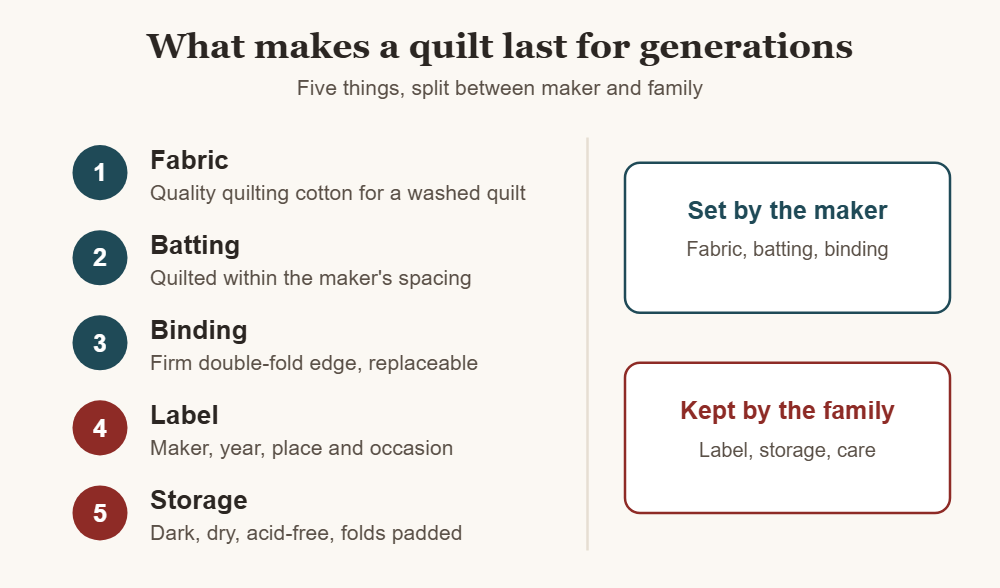
A quilt lasts when the fabric is good, the batting is held by enough quilting, and the edges are bound firmly. These choices belong to the maker, so ask about them before you buy or commission one.
Fabric. Quilting cotton is the standard for bed and lap quilts that will be washed. Some art quilts use other cloth on purpose, such as Ultrasuede appliqué or crystals, and those quilts suit the wall rather than the bed.
Batting and quilting distance. Every batting has a maximum distance between lines of quilting. Warm & Natural cotton batting can be quilted up to 10 inches apart, according to Missouri Star’s listing. Quilting closer than the maker’s limit keeps the batting from shifting over years of use. Our quilt batting guide compares cotton, wool and blends.
Binding. The binding takes the most wear on a bed quilt, because hands pull at the edges. A double-fold binding gives the edge two layers of fabric, and a worn binding can be replaced without touching the quilt top.
| Part | What helps it last | What to ask the maker |
|---|---|---|
| Fabric | Quality quilting cotton for washed quilts | What fabric is it? Was it prewashed? |
| Batting | Quilted within the batting maker’s spacing | What batting, and how far apart is the quilting? |
| Quilting | Even, secure stitches across the whole quilt | Hand, machine or longarm quilted? |
| Binding | Firm, double-fold binding | How is the binding attached? |
| Embellishments | None on bed quilts | Is it meant for a bed or a wall? |
Most of a quilt’s lifespan is set before it is given, by fabric, batting spacing and binding.
Why every heirloom quilt needs a label
A label keeps the quilt’s story attached to the quilt. Missouri Star advises at least the maker’s name, the year it was finished and where it was made, stitched down on all sides.
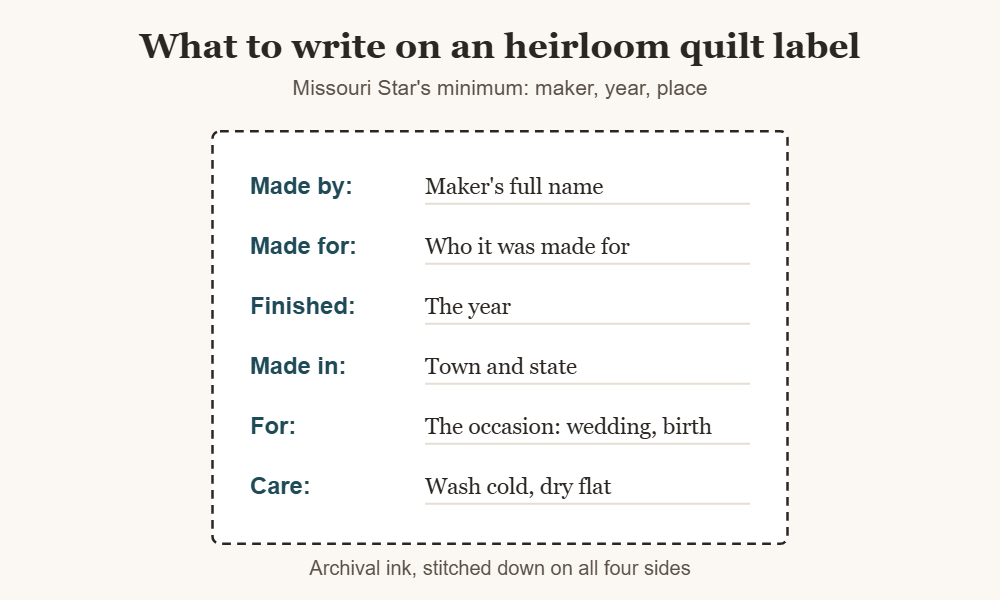
Add what the family will want to know later:
- Who made it, and who it was made for.
- When, the year it was finished.
- Where, the town and state.
- Why, the occasion: a wedding, a birth, a graduation, a retirement.
- How to care for it, in one line.
Write with archival ink. Pigma Micron pens use archival-quality, fade-resistant ink, according to Missouri Star’s listing, and many quilters use them for labels. Stitch the label to the back on all four sides, so it cannot be cut away without leaving a mark.
The WeAllSew blog from Bernina suggests asking older family members who made an inherited quilt and when, before that knowledge is gone. If you are passing on a family quilt rather than a new one, write that history down and keep it with the quilt.
How to store an heirloom quilt
Store a quilt clean, dry and dark, away from wood, cardboard and plastic sealed tight. Cushion the folds, and refold it from time to time so creases do not set.
The International Quilt Museum names temperature, humidity, pests and light as the things to control. Its guide warns that ordinary cardboard and wood give off acids that yellow and weaken textiles over time. University of Nebraska–Lincoln Extension says the same about wood, including cedar chests, and adds regular paper.
| Do | Avoid |
|---|---|
| Store in an acid-free box or wrapped in washed cotton muslin | Cardboard boxes, bare wood shelves and cedar chests |
| Pad each fold with acid-free tissue or a roll of muslin | Sharp folds left in the same place for years |
| Keep it in an interior closet, not the attic or basement | Heat, damp and places where pests live |
| Refold in a new pattern every few months | Sealed plastic bags that trap moisture |
| Store it clean | Putting a soiled quilt away |
The quilt’s enemies are light, heat, damp, acid and pests; good storage blocks all five.
To avoid permanent creases, Family Tree Magazine suggests refolding a quilt in thirds or sixths if it was folded in half or quarters before. The University of Delaware’s art conservation program advises storing quilts in an archival box in an interior closet. Acid-free boxes and unbuffered tissue are sold by museum suppliers such as Gaylord Archival, according to the WeAllSew blog.
How to display an heirloom quilt safely
Display a quilt out of direct sun and rotate it often. Light damage is permanent, according to the WeAllSew blog, so the safest display is a few months on and a rest in the dark.
- Hang the quilt on a wall that does not get direct sun.
- Use a hanging sleeve sewn to the back, so the weight spreads across the top edge.
- Rotate quilts on display, and rest each one in storage.
- On a bed, fold it back from a sunny window during the day.
A wall rack or quilt hanger spreads the weight better than nails or pins. A full guide to quilt hangers and display racks is coming to our quilting supplies section.
How to wash an heirloom quilt
Wash an heirloom quilt as little as possible. A sturdy modern cotton quilt can go in the machine on cold and gentle. Hand wash an antique or embellished quilt, or have a textile conservator check it first.
Our full guide on how to wash a quilt covers the colorfastness test, machine and hand washing, and drying. The short version for an heirloom: test the colors, wash cold and gentle, dry flat, and never put an antique quilt in a dryer. Art quilts with crystals or Ultrasuede should be dusted and spot cleaned, not washed.
Choosing a quilt to give as an heirloom
Choose a quilt by who will use it and how. A bed quilt for daily use needs washable cotton and sturdy quilting. A quilt that marks a milestone can be an art piece for the wall.
Think about the story as well as the size. A quilt in a pattern with meaning, such as a star for a new home or a block from a family quilt, carries more weight than a pretty print. A handmade quilt also costs more than a factory quilt because of the hours inside it; our guide to handmade quilt cost explains how makers price their work.
Handmade quilts from Joy Press
Joy Press makes and sells finished quilts and booth samples from her studio in Godley, Texas. Her listed quilts run from $45 to $1,500.
The top piece is Birds in a Swirl, a 60 × 60-inch quilt listed at $1,500. It won first place at the Dallas Quilt Celebration and the Arlington Quilt Show in 2002. Several of Joy’s art quilts carry crystals or Ultrasuede appliqué, which makes them wall pieces rather than bed quilts. Ask Joy how a piece should be cleaned and displayed before you buy it.
Browse her beautiful handmade quilts, or start with the full list of handmade quilts for sale. There is no online cart: call 817-223-8736, and Joy sends a Square invoice or takes a card by phone. Shipping on finished quilts is quoted per order.
Two kinds of “heirloom quilt”
Search for an heirloom quilt gift and most results are a different product from what this page covers. Shops use “heirloom quilt” for a small monogrammed baby quilt.
| Monogrammed “heirloom quilt” | Pieced heirloom quilt | |
|---|---|---|
| What it is | A whole-cloth quilt with machine embroidery and a name | A quilt pieced from many fabrics, made to last generations |
| Typical size | About 36 × 46 inches, often with a scalloped edge | Lap to king |
| Typical price | About $26 to $78 | Hundreds of dollars and up |
| Made by | Embroidery shops, often to order | A quilter, by hand or machine |
| Best for | A baby shower or a christening | A wedding, a milestone birthday, a family keepsake |
Prices and sizes from The Berry Basics, CeCe’s Home & Gifts, Wilde Poppy Heirlooms and Etsy listings on Google Shopping, 28 November 2026.
Both can become heirlooms. The difference is how well each one is built to survive washing and use.
How to judge whether a gift quilt will last
Check the fabric, the stitching and the label before you buy. These three things decide whether a quilt survives decades of use.
- 100% cotton fabric on the top and back. CeCe’s Home & Gifts, for example, lists its baby quilts as 100% cotton.
- Close quilting stitches. Stitch lines a few inches apart hold the batting in place through washing.
- A firm, even binding around the edge, with no loose threads.
- A label with the maker’s name and the date. It is what turns a quilt into a family record.
Our guide to how to wash a quilt explains care that keeps a quilt in good shape.
Memorial and wedding keepsake quilts
Heirloom quilts are also made to remember a person or an event. Two kinds come up often.
- Memorial quilts are embroidered or pieced with a loved one’s name and dates. Some are made from their clothing.
- Wedding keepsake quilts collect blocks signed by guests, or include photos and vows. Wedding Keepsake Quilts designs them block by block.
These are made to order and take time. Allow several weeks, and ask the maker about the timeline before you commit.
What to do next
Decide first whether the quilt will be used on a bed or shown on a wall, because that sets the fabric, quilting and care. Then ask the maker about the batting and quilting distance, and add a label with the maker, year, place and occasion in archival ink. Give the family a storage note: acid-free box or washed muslin, an interior closet, folds padded and changed every few months, no cedar chest. For a finished quilt with a story already sewn in, call Joy Press at 817-223-8736 and ask about her handmade quilts, or see her beautiful handmade quilts.
Heirloom quilt gift questions
What makes a quilt an heirloom?
Good materials, close enough quilting to hold the batting, a label with its story, and careful storage. Those four things let a family use the quilt and still pass it down.
How do you label an heirloom quilt?
Write the maker’s name, the year and the place on a fabric label with archival ink, such as a Pigma Micron pen. Add who it was made for and why. Stitch it to the back on all four sides.
How should an heirloom quilt be stored?
Clean, in an acid-free box or wrapped in washed cotton muslin, in an interior closet. Pad the folds and refold it every few months. Keep it away from wood, cardboard, light, heat and damp.
Is a cedar chest good for storing quilts?
No. University of Nebraska–Lincoln Extension advises keeping stored textiles from touching wood, including cedar chests. Line any wooden storage with washed muslin or use an archival box.
Can you wash an heirloom quilt?
A sturdy modern cotton quilt can be machine washed on cold and gentle and dried flat. Hand wash antique or fragile quilts, or ask a textile conservator first. Spot clean quilts with crystals or appliqué.