
By Shariful Alam Pavel · Updated 28 November 2026
A quilt on the wall is art you can see every day. Hang it the wrong way, though, and gravity does slow damage: pins tear the fabric, nails leave rust, and a quilt hung from two corners sags and distorts. To hang a quilt on the wall safely, support the whole top edge. The best method is a fabric sleeve sewn across the back with a rod or slat through it. Museums often use a hook-and-loop (Velcro) strip on a wall board. Keep the quilt out of direct sun and away from heat vents. This guide covers every method step by step, including no-nail and renter-friendly options, framing and vintage quilts.
Key facts
- Never use nails, staples, tacks or pins to hang a quilt; they create severe stress in small areas, according to University of Nebraska–Lincoln Extension.
- Don’t display quilts on an outside wall or near a heating vent, according to UNL Extension.
- A fabric hanging sleeve with a rod through it spreads the weight evenly, according to Missouri Star, which calls it the gold standard.
- The Velcro method suits quilts in good condition that can bear their own weight, according to the Canadian Conservation Institute.
- The Velcro mount is not appropriate for every textile; fragile pieces need a conservator, according to the George Washington University Museum and The Textile Museum.
- Take a hung quilt down every three to four months, or swap it with the seasons, according to Martha Stewart.
What is the best way to hang a quilt on the wall?
Support the full width of the top edge. A sewn sleeve with a rod or slat is the best method for most quilts; a Velcro strip on a board is best for heavy or valuable ones.
| Method | Best for | Damage risk | Effort |
|---|---|---|---|
| Sleeve and rod or slat | Most wall and bed quilts | Low | Sew a sleeve |
| Velcro on a wall board | Heavy, large or valuable quilts | Lowest when done right | More work |
| Clamp or clip hanger | Small, sturdy wall quilts | Low to medium | No sewing |
| Corner pockets and dowel | Mini quilts | Low | Sew before binding |
| Curtain rod with clip rings | Quilts you swap often | Low to medium | No sewing |
| Command strips and a slat | Renters, light quilts | Low on the quilt | No drilling |
| Magnetic clips | Small quilts on metal doors | Low to medium | None |
| Quilt ladder or rack | Folded display | Low; refold often | None |
| Nails, pins, tacks | Never | High | — |
Ranked from museum and extension guidance; see the sections below.
How do you hang a quilt with a sleeve and rod?
Sew a fabric tube across the back near the top edge, slide a rod or flat slat through it, and rest the rod on brackets.
- Cut the sleeve. For a 4-inch finished sleeve, cut a strip 8 1/2 inches wide by the quilt’s width minus about an inch, as Missouri Star advises.
- Hem the ends. Turn under each short end and stitch, so the rod slides in cleanly.
- Fold and sew. Fold the strip in half lengthwise, wrong sides together, and sew the long edge.
- Leave some ease. Pin the sleeve so its back layer has a little slack. The rod then sits in the tube without pulling the quilt.
- Hand stitch it on. Sew the top and bottom edges of the sleeve to the backing only, not through to the front. UNL Extension suggests large stitches, about 1/4 inch or longer.
- Insert the rod. A flat wooden slat or metal rod a little shorter than the sleeve.
- Mount it. Rest the ends on brackets, screws or cup hooks, hidden behind the quilt.
The Canadian Conservation Institute’s basic quilt care guide describes running an enameled metal extension curtain rod through a sewn casing and resting it on wall brackets.
How wide should a quilt hanging sleeve be?
A 4-inch finished sleeve is the common standard and the size most quilt shows ask for. Large or heavy quilts can use a wider sleeve.
| Quilt | Sleeve (finished) | Cut strip |
|---|---|---|
| Mini or small wall quilt | Corner pockets or 2 to 3 in. | 4 1/2 to 6 1/2 in. |
| Wall quilt or show quilt | 4 in. | 8 1/2 in. |
| Large or heavy quilt | 4 to 6 in. | 8 1/2 to 12 1/2 in. |
Cut width = 2 × finished width + 1/2 inch for seams. Our arithmetic; 4-inch standard per Missouri Star.
Not sure which size your quilt counts as? Check it against our quilt sizes chart. The Louisiana Folklife Program describes a muslin sleeve about six inches wide for vertical display of documented quilts.
How do you hang a small quilt without a sleeve?
Sew two fabric triangles into the top corners before binding, then slip a dowel or flat stick into them. It works for mini quilts and small wall hangings.
- Cut two squares of fabric, about 4 to 6 inches.
- Fold each in half diagonally, wrong sides together, to make a triangle.
- Pin one in each top corner on the back, raw edges matching the quilt edges.
- Bind the quilt. The binding catches the triangles.
- Slide in a stick cut to fit between the pockets, and hang it on a small nail or hook.
American Patchwork & Quilting teaches this triangle method as one of its two main hanging methods, with the continuous sleeve for larger quilts. The pockets are hidden from the front, and nothing pierces the quilt.
How do you hang a quilt without nails?
Use Command strips to hold a slat or hooks on the wall, a tension or curtain rod with clip rings, or magnetic clips on metal. These suit renters and walls you cannot drill.
| No-nail method | How it works | Watch for |
|---|---|---|
| Command strips holding a slat | Strips on the wall carry a light wooden slat in the sleeve | Weight limit on the package |
| Command hooks and a rod | Two or three hooks carry a rod through the sleeve | Hooks must be level |
| Clothespins on Command strips | Wooden clothespins grip the top edge | Small, light quilts only |
| Curtain rod with clip rings | Clips grip the top edge every few inches | Clips concentrate stress |
| Magnetic clips | Clips hold a mini quilt to a metal door or shelf | Very light pieces only |
Methods shown by American Patchwork & Quilting, Patchwork and Poodles and r/quilting members.
Patchwork and Poodles’ tutorial starts by cleaning the wall with rubbing alcohol before applying strips. Reddit’s r/quilting members add a cure time: give the strips 24 to 48 hours to bond before hanging any weight.
We would not stick adhesive strips straight onto the quilt fabric. Put them on the wall, a slat or a label patch you can remove. The top r/quilting answer uses a curtain rod with clips, which makes swapping quilts easy.
How do museums hang quilts? The Velcro method
Museums stitch the soft half of a Velcro strip to a cotton band and hand-sew the band to the quilt. The hook half goes on a wooden board on the wall.
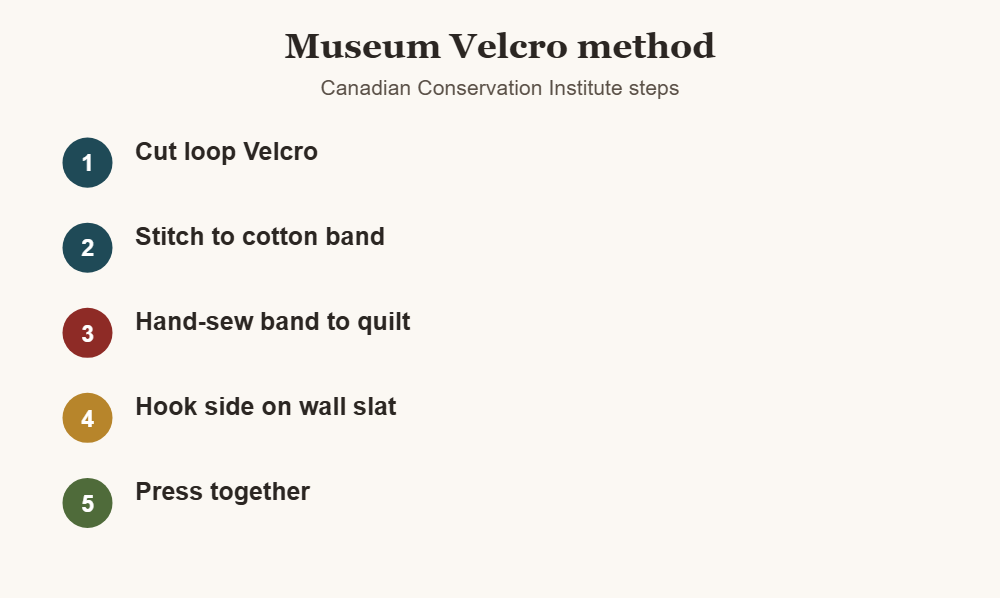
The Canadian Conservation Institute gives the method in steps. A short version:
- Cut the Velcro loop side about 2 cm (3/4 in.) shorter than the quilt’s top edge.
- Make a cotton sleeve about 0.5 cm wider all around than the Velcro, and machine stitch the loop Velcro onto it.
- Hand-sew the sleeve to the back of the quilt, working from the center out, with a running or herringbone stitch.
- Fix the hook side of the Velcro to a sealed wooden slat mounted on the wall.
- Press the two halves together to hang the quilt.
CCI explains that Velcro is too stiff to sew directly onto a textile without stress, which is why it goes on a cotton band first. The Minnesota Historical Society describes the same approach, with the hook side stapled to a wood slat mounted on a cleat.
Which method should you use for your quilt?
Match the method to the quilt’s size, weight and value.
| Your quilt | Best method |
|---|---|
| New wall quilt or small art quilt | Sleeve and slat, or a clamp hanger |
| Large bed quilt | Sleeve with a long rod, or Velcro board |
| Heirloom or antique in good condition | Velcro board, hand-sewn |
| Fragile, silk or heavily beaded quilt | Don’t hang it; ask a textile conservator |
| Quilt you swap with the seasons | Sleeve, so rods can be reused |
Based on CCI, GWU Museum and UNL Extension guidance.
Suzy Williams of Suzy Quilts told Yahoo Lifestyle that if the next quilt in your rotation is about the same size, you can reuse the same rod and sleeve.
How do you hang a vintage or antique quilt?
Use the Velcro board method, sewn by hand to a cotton band. Never use clips, clamps or strips on an old quilt, and hang it only if it is sound.
- Check it first. Look for split seams, brittle fabric and loose binding. If the quilt cannot carry its own weight, display it flat or folded instead.
- Spread the weight. A full-width band is better than a sleeve for an old, heavy quilt.
- Keep the light low. Old dyes fade fast. Indirect light only.
- Rest it often. Take it down and let it lie flat between display periods.
- Ask a conservator for silk, wool, beaded or damaged quilts.
The George Washington University Museum and The Textile Museum note that the Velcro mount is not right for every textile. A quilt with a family history is worth a conservator’s opinion before it goes on the wall.
How do you frame a quilt for the wall?
Small quilts can be framed in a deep shadow-box frame or wrapped over a fabric-covered board. Large quilts should hang from a sleeve or band instead.
- Shadow box. Use a deep frame so the glass does not press on the quilt.
- Fabric-covered board. Cover a board with cotton, then hand-stitch the quilt to the cotton at a few points. Do not glue it.
- Acid-free materials keep the backing from yellowing the quilt over time.
- UV-filtering glass or acrylic slows fading if the room gets light.
Framing tips are our own suggestions based on the conservation advice above; a professional framer can advise on your piece.
Where should you hang a quilt?
Choose an inside wall out of direct sunlight, away from heat vents, fireplaces and kitchens.
- No direct sun. Light fades fabric over time. SAQA notes that conservators recommend indirect lighting for textile display.
- Inside walls. UNL Extension advises against outside walls and heating vents.
- Away from moisture such as bathrooms and laundry rooms.
- A little air space. SAQA shows using a wingnut on the mounting screw so the rod sits slightly away from the wall.
Common quilt-hanging mistakes
Most damage comes from point stress, light and leaving a quilt up too long.
- Hanging from corners or pins. It stretches and tears the quilt.
- Using a round dowel for a heavy quilt. Austin Gallery recommends a flat slat instead.
- Sewing through to the front when attaching a sleeve.
- Hanging in a sunny window. Fading cannot be undone.
- Never taking it down. Martha Stewart advises taking a hung quilt down every three to four months, or swapping it with the seasons, so gravity does not strain the seams.
- Hanging it before it is clean. Dust and oils set in over months on the wall.
Other ways to display a quilt at home
Not every quilt has to hang. A ladder, rack, shelf or the foot of a bed shows a quilt with less strain.
| Display | Best for | Tip |
|---|---|---|
| Quilt ladder | Two or three folded quilts | Refold along new lines often |
| Wall-mounted quilt rack | One quilt draped over a bar | Pad the bar with cotton |
| Open shelf or cabinet | Stacks of folded quilts | Keep out of sun |
| Foot of the bed | Everyday use | Swap with the seasons |
| Old drawer with a dowel | Mini wall hangings | A Snuggles Quilts idea |
Display ideas from APQS and Snuggles Quilts.
APQS warns that wood racks and ladders should be sealed or treated so they do not damage the quilt. A cotton sheet between bare wood and the quilt works too.
Dedicated quilt hangers, such as clamp-style wooden hangers, are another option. Our guide to quilt hangers is coming soon.
Hanging Joy Press’s quilts and barn quilts
Joy Press’s Two-Fabric Bargello quilts finish at 33 × 53, 40 × 55 and 46 × 57 inches, all good wall sizes. A 4-inch sleeve and a flat slat suit them well. See the designs on the Two-Fabric Bargello quilt kit page.
A low-loft batting helps a Bargello hang flat so the color waves read cleanly. For an outdoor alternative, a painted barn quilt is made to hang on a barn or fence; see our barn quilts guide.
What to do next
Look at your quilt and decide how much it weighs and how much it matters. Sew a 4-inch sleeve for most quilts, or use the Velcro board method for heavy and heirloom pieces. Hang it on an inside wall out of the sun, away from vents, and never use nails or pins. Our how to wash a quilt guide covers cleaning before and after display. For more on caring for and buying quilts, start at our handmade quilts section. If you are buying a quilt for the wall, our handmade quilt cost guide explains what fair prices look like. When you are ready, browse Joy Press’s handmade quilts for sale.
Hanging a quilt questions
How do you hang a quilt without damaging it?
Support the whole top edge with a sewn sleeve and rod, or a Velcro board. Never use nails or pins.
What size should a quilt hanging sleeve be?
About 4 inches finished; cut the strip 8 1/2 inches wide.
How do you hang a quilt on the wall without nails?
Use Command strips or hooks to hold a slat or rod through a sleeve, or a curtain rod with clip rings. Keep adhesive off the quilt itself.
How do you hang a vintage quilt?
Hand-sew a cotton band with loop Velcro to the back and press it onto a hook strip on a wall board. Hang it only if it is sound.
Where should I not hang a quilt?
Not in direct sun, on an outside wall or near a heating vent.
How do museums hang quilts?
With a hook-and-loop (Velcro) strip on a cotton band, hand-sewn to the quilt and pressed onto a wall board.