
By Shariful Alam Pavel · Updated 28 November 2026
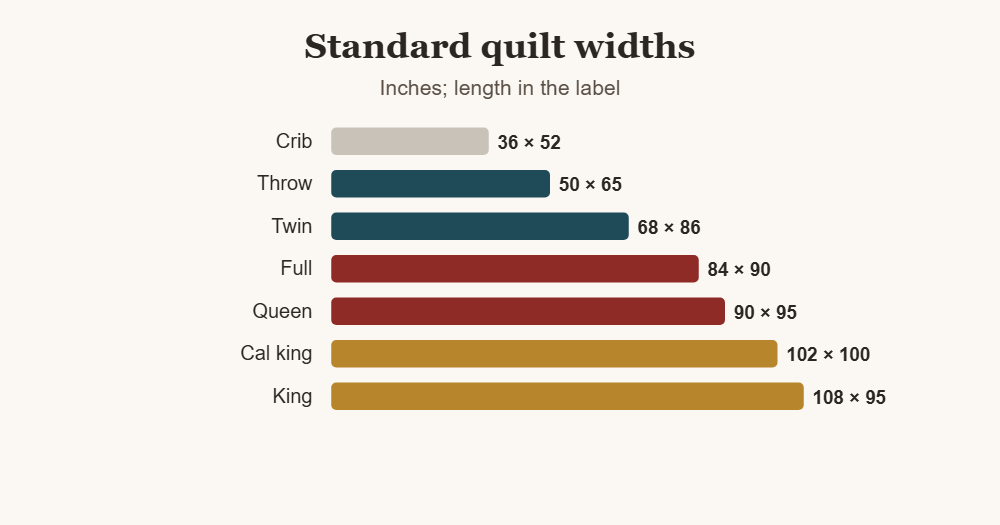
The most common quilt mistake happens before the first cut: making a quilt the wrong size for the bed. A queen quilt is not 60 by 80 inches. That is the mattress. The quilt has to cover the mattress and hang down the sides. Standard quilt sizes are about 36 × 52 inches for a crib, 50 × 65 for a throw and 68 × 86 for a twin. A full is about 84 × 90, a queen 90 × 95 and a king 108 × 95. Each gives about 15 inches of drop. This guide gives the full chart in inches and centimeters, the formula for any bed, batting sizes, precut math and why charts disagree.
Key facts
- Missouri Star lists standard quilt sizes as crib 36 × 52, throw 50 × 65 and twin 68 × 86 inches. Full is 84 × 90, queen 90 × 95, king 108 × 95 and California king 102 × 100.
- Standard mattresses are twin 38 × 75, twin XL 38 × 80 and full 54 × 75 inches, according to Homes & Gardens. Queen is 60 × 80, king 76 × 80 and California king 72 × 84.
- A crib mattress is 28 × 52 inches, according to Homes & Gardens.
- Quilt width = mattress width + 2 × drop; quilt length = mattress length + drop + pillow tuck, according to Missouri Star.
- Warm & Natural batting comes in baby 45 × 60, twin 72 × 90 and full 90 × 96 inches, according to Linda’s Electric Quilters. Queen is 90 × 108 and king 124 × 120.
Standard quilt sizes chart
Here are standard quilt sizes, the mattress each fits, and the side drop you get. The drop is how far the quilt hangs over each side.
| Quilt | Quilt size (in.) | Quilt size (cm) | Mattress size (in.) | Side drop |
|---|---|---|---|---|
| Crib | 36 × 52 | 91 × 132 | 28 × 52 | About 4 in. |
| Throw or lap | 50 × 65 | 127 × 165 | — | — |
| Twin | 68 × 86 | 173 × 218 | 38 × 75 | About 15 in. |
| Twin XL | 68 × 95 | 173 × 241 | 38 × 80 | About 15 in. |
| Full (double) | 84 × 90 | 213 × 229 | 54 × 75 | About 15 in. |
| Queen | 90 × 95 | 229 × 241 | 60 × 80 | About 15 in. |
| King | 108 × 95 | 274 × 241 | 76 × 80 | About 16 in. |
| California king | 102 × 100 | 259 × 254 | 72 × 84 | About 15 in. |
Quilt sizes from Missouri Star; mattress sizes from Homes & Gardens. Twin XL quilt size, centimeters (inches × 2.54, rounded) and side drop are our own arithmetic. Twin XL adds the extra 5 inches of mattress length to a twin quilt.
Missouri Star notes that finished sizes can vary by 2 to 4 inches with your pattern, binding and batting loft.
Why do quilt size charts disagree?
Because there is no official quilt standard. Mattress sizes are fixed by the bedding industry; quilt sizes are a choice of drop, tuck and pattern. Each chart picks its own.
Stitchin’ Heaven gives a whole section to this question, and quilting groups ask it again and again. One beginner in a Facebook group made a twin quilt in a class at 55 × 84 inches. Pinterest charts showed twins at 70 to 75 × 88 to 90 inches. Both can be “twin.” The smaller one is a coverlet that sits on top of the bed. The larger one hangs well down the sides.
| What changes the number | Effect on the chart |
|---|---|
| Drop chosen (coverlet vs full drop) | Up to 20 in. difference in width |
| Pillow tuck included or not | 8 to 12 in. difference in length |
| Pattern block size | Sizes round to fit whole blocks |
| Mattress depth assumed | Deeper beds need wider quilts |
| Shrinkage after washing | Cotton can lose 3 to 5% |
Why two honest charts can differ.
So treat any chart as a starting point. Measure your own bed, pick your drop and use the formula below. Missouri Star puts cotton shrinkage at 3 to 5% after the first wash and suggests adding 2 to 3 inches if you need an exact finished size.
Small quilt sizes: wall, table, baby and lap
Not every quilt goes on a bed. Small quilts have looser standards, so plan them around where they will hang or who will use them.
| Quilt | Typical size | Use |
|---|---|---|
| Mini or mug rug | 6 × 10 to 24 × 24 in. | Table, small wall |
| Table runner | 12 to 18 × 36 to 72 in. | Dining table |
| Wall hanging | 24 × 24 to 60 × 60 in. | Wall display |
| Baby or crib | 36 × 52 in. | Crib, stroller, play mat |
| Throw or lap | 50 × 65 in. | Sofa, reading chair |
| Toddler | About 45 × 60 in. | Toddler bed, nap mat |
| Wheelchair or lap robe | About 36 × 40 in. | Covers the lap without catching in wheels |
Small-quilt sizes are ranges, our guide based on common patterns; crib, throw, toddler and wheelchair sizes from Missouri Star.
Joy Press’s Two-Fabric Bargello quilts are wall and lap sizes. The Swirl is 33 × 53 inches, the Check Mark 40 × 55 and the Lightning Bolt 46 × 57.
How do you calculate a quilt size for any bed?
Measure the mattress, decide on a drop, and add it. Use the formula: width = mattress width + 2 × drop; length = mattress length + drop + pillow tuck.
- Measure the mattress width, length and depth.
- Choose a side drop. Most quilters add 10 to 12 inches per side, according to Missouri Star. To reach the floor or cover a bed skirt, measure from the mattress top to where you want the quilt to end.
- Choose a pillow tuck of 10 to 12 inches if the quilt will fold under the pillows, as Mattress Stores Los Angeles suggests.
- Add it up. Width = mattress width + 2 × drop. Length = mattress length + drop + tuck.
Example: take a 60 × 80-inch queen mattress, a 14-inch drop and a 10-inch tuck. The quilt is 60 + 28 = 88 inches wide and 80 + 14 + 10 = 104 inches long.
What about deep mattresses and pillow-top beds?
Measure the depth. A standard queen quilt gives about 15 inches of drop, which barely covers many modern mattresses with toppers.
Mattress Stores Los Angeles points out that a 90-inch queen quilt’s 15-inch drop was generous when mattresses were 8 or 9 inches deep. With a 14-inch mattress and a topper, that same quilt may stop at the mattress edge.
| Mattress depth | Side drop to cover it | Queen quilt width |
|---|---|---|
| 9 in. | 12 in. | 84 in. |
| 12 in. | 15 in. | 90 in. |
| 14 in. | 17 in. | 94 in. |
| 16 in. (pillow top) | 19 in. | 98 in. |
Our own arithmetic: drop = depth + 3 inches of overhang; width = 60 + 2 × drop.
Quilt batting sizes chart
Buy batting a few inches larger than the quilt top on every side. Packaged batting comes in standard sizes that match common quilts.
| Package | Warm & Natural size | Pellon polyester size |
|---|---|---|
| Craft | — | 34 × 45 in. |
| Baby or crib | 45 × 60 in. | 45 × 60 in. |
| Throw | — | 60 × 60 in. |
| Twin | 72 × 90 in. | 72 × 96 in. |
| Full | 90 × 96 in. | 81 × 96 in. |
| Queen | 90 × 108 in. | 90 × 108 in. |
| King | 124 × 120 in. | 120 × 120 in. |
Sizes from Linda’s Electric Quilters’ Warm & Natural and Pellon guides. Check the package; sizes vary by brand.
Our types of quilt batting guide explains loft and shrinkage. Remember that cotton batting can shrink, which slightly reduces the finished size.
How much fabric for each quilt size?
Fabric depends on the pattern, but backing and binding follow simple rules. Backing must be about 8 inches larger than the top each way.
| Quilt | Backing (42-in. cotton) | Binding (2.5-in. strips) |
|---|---|---|
| Crib 36 × 52 | About 2 1/2 yd | About 3/8 yd |
| Throw 50 × 65 | About 3 1/4 yd | About 1/2 yd |
| Twin 68 × 86 | About 5 1/4 yd | About 5/8 yd |
| Full 84 × 90 | About 7 3/4 yd | About 3/4 yd |
| Queen 90 × 95 | About 8 1/4 yd | About 3/4 yd |
| King 108 × 95 | About 8 5/8 yd | About 7/8 yd |
Our own arithmetic: backing adds 8 inches each way with 40 usable inches; binding uses perimeter + 20 inches, strips of 40 inches.
For exact numbers, use our quilting fabric calculator, quilt backing calculator and quilt binding calculator.
How big a quilt will precuts make?
A charm pack of 42 five-inch squares makes a quilt top about 27 × 31 1/2 inches, sewn straight, with no borders. A layer cake of 42 ten-inch squares makes about 57 × 66 1/2 inches.
| Precut | Pieces | Finished piece | Straight grid | Top size before borders |
|---|---|---|---|---|
| Charm pack | 42 squares, 5 in. | 4 1/2 in. | 6 × 7 | 27 × 31 1/2 in. |
| Layer cake | 42 squares, 10 in. | 9 1/2 in. | 6 × 7 | 57 × 66 1/2 in. |
| Jelly roll | 40 strips, 2 1/2 in. × 42 in. | 2 in. wide | Depends on pattern | About a throw |
Our own arithmetic: each square loses 1/2 inch to seams. Piece counts from Missouri Star.
Missouri Star says one charm pack makes a generous baby quilt, two a lap or throw and four a twin. That assumes borders, sashing or a background fabric. One layer cake makes a lap quilt, and one jelly roll a throw. Our guide to jelly roll quilt kits shows what each pattern needs.
Which size should your first quilt be?
A baby, lap or throw quilt. It is quick to piece and easy to quilt on a home machine.
A first quilt at queen size means a lot of cutting and a heavy quilt to push through a home machine. Our guide on how to make a quilt for a beginner walks through a first quilt from start to finish. If you want everything in one box, see our quilt kits for beginners.
What to do next
Measure your mattress, including its depth, before you choose a pattern. Pick a drop that covers the sides, add a pillow tuck if you want one, and work out your finished size with the formula above. Then buy batting and backing a little larger than the top. For a first quilt, start small: Joy Press’s Two-Fabric Bargello quilt kit makes a 33 × 53 to 46 × 57-inch wall or lap quilt for $50. See more in our learn to quilt section.
Quilt size questions
What size is a queen quilt?
About 90 × 95 inches, according to Missouri Star, for a 60 × 80-inch mattress.
What size is a king quilt?
About 108 × 95 inches for a 76 × 80-inch king mattress.
What size is a twin quilt?
About 68 × 86 inches for a 38 × 75-inch twin mattress.
What size is a throw or lap quilt?
About 50 × 65 inches.
How much drop should a quilt have?
Most quilters plan 10 to 12 inches per side; deep mattresses need more.
What size is a queen quilt in cm?
About 229 × 241 cm, from 90 × 95 inches.
How big a quilt will 42 5-inch squares make?
About 27 × 31 1/2 inches in a straight 6 × 7 grid, before borders.