
By Shariful Alam Pavel · Updated 28 November 2026
Basting is the step most quilters dread: crawling on the floor, pinning every few inches, and still finding puckers on the back. Basting spray turns that hour into a few minutes. Basting spray for quilting is a temporary, repositionable fabric adhesive that holds the top, batting and backing together while you quilt, then washes out. The best-known brands are Odif 505 and HeatnBond Spray n Bond, with June Tailor and Sullivans as lower-cost choices. This guide compares six sprays and shows how to baste without puckers. It also covers homemade spray and when pins or glue work better. Team Joy’s Fabrics reviews and researches these products; we have not tested them.
Key facts
- 505 Spray and Fix is odorless, colorless, acid-free, contains no CFCs and does not gum needles, according to eQuilter and Fat Quarter Shop.
- 505 is sold in small cans of about 6.2 to 7.2 ounces and a 14.7-ounce can, according to Quilt Beginnings and Quality Sewing.
- A 2026 comparison by Mary Go Round Quilts named Spray n Bond its top pick for hold and washability.
- Hold the 505 can about 12 inches from the fabric and spray the wrong side of the smaller piece, according to the product directions listed by All Brands.
- June Tailor basting spray is recommended for quilts in 100% cotton fabric and batting, not appliqué, according to New Quilters.
- 505 washes out and can be cleaned off surfaces with warm, soapy water, according to its Walmart listing.
What is basting spray and how does it work?
Basting spray is a light, temporary glue in an aerosol can. It holds the three quilt layers in place without pins, and it releases so you can lift and smooth a layer.
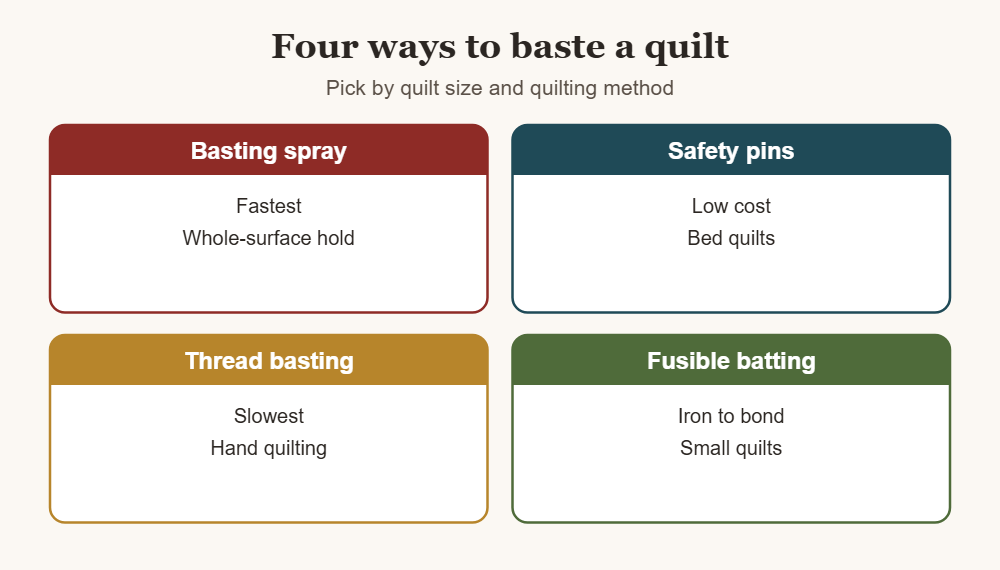
A basted quilt sandwich is the top, the batting and the backing held flat so they do not shift while you quilt. Pins and thread basting do this at points. Spray holds the whole surface, so the layers cannot creep between pins.
| Basting method | Speed | Hold | Best for |
|---|---|---|---|
| Basting spray | Fastest | Whole surface | Wall quilts, lap quilts, home machines |
| Safety pins | Medium | At each pin | Bed quilts, frugal quilters |
| Thread basting | Slowest | Along stitch lines | Hand quilting |
| Fusible batting | Fast | Whole surface, with iron | Small quilts |
| Longarm frame | No basting needed | Frame holds layers | Quilts sent out to a longarmer |
Choose by quilt size and how you will quilt it.
Basting spray is also used to hold appliqué pieces, templates and embroidery stabilizer in place. This guide sticks to quilt basting. (It is not the cooking spray of the same name.)
Basting spray compared: 505, Spray n Bond, June Tailor, Sullivans and more
505 and Spray n Bond get the most praise. June Tailor and Sullivans cost less, and forum users report more smell from them.
| Spray | Maker’s main claims | Can size and price seen | What quilters report |
|---|---|---|---|
| Odif 505 Spray and Fix | Odorless, colorless, acid-free, no needle gumming | 6.2 oz $13.95; 7.2 oz $11.98; 14.7 oz $23.95 | Most praised for low smell |
| HeatnBond Spray n Bond Basting Adhesive | Acid-free, solvent-free, temporary | 7.2 oz about $15.60 to $19.20 | Top pick in Mary Go Round’s 2026 comparison |
| June Tailor Quilt Basting Spray | For 100% cotton quilts | 10 oz about $14 | Budget pick; some report smell and a stiffer feel |
| Sullivans Quilt Basting Spray | Bonds cotton or poly batting | 10 oz about $8 to $10 | Lowest price; one forum user called it smelliest |
| Riley Blake Quilty Basting Spray | Temporary and repositionable | About $15 to $20 | Newer; few reports yet |
| Pellon Spray n Tack | Temporary adhesive | About $15 | Few quilt-specific reports |
Based on our research of maker listings, shop listings and quilter reports, not our own testing. Prices from Fat Quarter Shop, eQuilter, Quilt Beginnings and Google Shopping, 28 November 2026. They change often.
New Quilters notes that 505, June Tailor and Sullivans all say they are odorless, colorless and repositionable, and all claim not to gum the needle. Thermoweb describes Spray n Bond as a temporary bond for the design phase, including piecing and appliqué placement.
In a 2026 video comparing three sprays, Mary Go Round Quilts chose Spray n Bond for its secure hold and washability. The same video advised against June Tailor, citing its sticky aerosol spray. That is one quilter’s result, not a lab test.
What do quilters say about each spray?
Quilter reports on forums lean toward 505, mainly for its lack of smell, with June Tailor and Sullivans as budget picks.
- 505: One Quiltingboard user wrote that 505 can be used indoors while June Tailor’s can said to use it in a well-ventilated place. Another reported basting four queen quilts with one can of 505.
- June Tailor: Some Quiltingboard users found it made a stiffer quilt sandwich than 505 and had more smell. Others use it happily and buy it on sale.
- Sullivans: A Quiltingboard user who prefers Sullivans called it the worst smelling of the four sprays they tried.
- Others: Quilters also mention Helmar 101 and Therm O Web Spray n Bond as alternatives.
These are individual quilter reports, not test results. Experiences vary with technique and humidity.
How do you spray baste a quilt?
Spray a light coat on the batting, smooth the backing onto it, then repeat for the top. Work from the center out.
- Prepare. Press the top and backing. The backing should be 4 inches larger than the top on every side.
- Protect the area. Cover the floor or wall with paper or an old sheet. Overspray is sticky.
- Ventilate. Open a window or work outside, and read the can’s warnings.
- Lay the batting flat and fold back half of it.
- Shake the can and spray a light, even coat from about 12 inches away.
- Smooth the layer onto the sprayed area from the center out.
- Repeat for the other half, then flip and do the top.
All Brands lists 505’s directions as spraying the wrong side of the smaller piece and notes that a light spray is enough. A heavy coat makes the quilt stiff and can gum the needle.
A few tricks make the job easier:
- Skip the kneeling. Beth Ann Williams shows rolling the layers onto a pool noodle on a broom handle. You spray and unroll at table height.
- Heat-set the sandwich. The same video suggests pressing the basted quilt with a dry iron to set the spray. That cuts needle stickiness.
Is basting spray the same as adhesive spray?
No. Basting spray is a temporary fabric adhesive made to release and wash out. General craft adhesive sprays can be permanent and should not go on a quilt.
Read the can before you buy. Look for “temporary,” “repositionable” and “washes out” on the label. If it says permanent, bonding or for mounting, it is the wrong product.
Getting the backing size right first saves a lot of trouble. Our guide to quilt backing fabric has a yardage chart for every size.
How much basting spray do you need?
A small can covers a lap or throw quilt with care. Large quilts may need a large can or two small ones.
| Quilt size | Spray to have on hand |
|---|---|
| Wall or baby | 1 small can (7 oz), with spray left over |
| Throw or lap | 1 small can, maybe a large one |
| Twin | 1 large can (about 14 oz) |
| Queen or king | 1 to 2 large cans, or pin baste instead |
Our rough guide for planning, not a maker figure. Light coats go much further.
One Quiltingboard user reported getting four queen quilts from one can of 505, which shows how far a light coat goes.
Does basting spray wash out?
Yes. Temporary basting sprays are made to wash out. 505’s Walmart listing says it disappears when washed and leaves no residue.
Wash the finished quilt once to remove the adhesive, especially before giving it to a baby. Our types of quilt batting guide explains which battings shrink in that first wash. If you used wool batting, follow the gentle care steps in our wool quilt batting guide.
Is basting spray safe?
Use it in a well-ventilated room or outdoors, keep it away from heat, and follow the can’s warnings. Aerosol adhesives carry safety labels for a reason.
- Ventilate even with “odorless” sprays.
- Keep it off the sewing machine and floors you walk on.
- Store it upright and away from heat.
- Test on scraps of the same fabric and batting first.
When is basting spray the wrong choice?
Skip spray for very large quilts on a floor, for wool or silk you cannot wash, or if spray fumes bother you.
| Situation | Better choice |
|---|---|
| King quilt on a small floor | Pin baste, or send to a longarmer |
| Fumes bother you | Pins or fusible batting |
| Hand quilting over months | Thread basting |
| Quilt sent to a longarmer | No basting; the frame holds layers |
Match the method to the quilt.
Can you make your own basting spray?
Yes. Homemade basting spray is a thin starch made from flour and water, sprayed on and ironed dry. It costs pennies, has no aerosol fumes and washes out.
String & Story publishes a recipe that uses flour, water, salt and rubbing alcohol or odorless vodka. The flour gives the hold, and the alcohol helps it dry faster. You spray it on, smooth the layer and press it dry with an iron.
| Homemade flour spray | Store-bought basting spray | |
|---|---|---|
| Cost | Very low | About $8 to $24 a can |
| Fumes | None from aerosol | Ventilation needed |
| Hold | Firm once pressed dry | Repositionable while tacky |
| Work | Mix, spray, iron dry | Spray and smooth |
| Must wash out | Yes, before storing | Yes, at first wash |
How the two approaches compare, from String & Story’s recipe and maker listings.
Wash a flour-basted quilt once it is finished, so no starch stays in the fibers.
What can you use instead of basting spray?
Safety pins, thread basting, fusible batting and washable school glue all work. Each trades speed for cost, comfort or hold.
- Curved safety pins every few inches. Cheap and reusable; slow on large quilts.
- Thread basting in a large grid. Best for hand quilting.
- Fusible batting bonded with an iron. Fast for small quilts.
- Washable school glue, dotted or drizzled and heat-set. Quiltingboard members have discussed Elmer’s washable glue as a low-cost option.
- A longarm quilter. The frame holds the layers, so no basting is needed.
Our guide to beginning quilting supplies lists the pins and tools for each method. If spray has gummed your needle before, our best sewing machine for quilting guide covers needles and feet too.
Tools that pair with basting spray
A wool pressing mat helps set a sprayed sandwich and press blocks flat before basting. See our guide to the wool pressing mat.
What to do next
Pick 505 or Spray n Bond if smell bothers you and you want the most praised sprays. Pick June Tailor or Sullivans to save money if you can work in a ventilated space. Try homemade flour spray if you want no aerosol at all. Cut your backing 4 inches bigger than the top on every side, spray lightly from 12 inches, and smooth from the center out. If you are ready for a quilt worth basting, start with Joy Press’s Two-Fabric Bargello quilt kit for $50. See the full list of tools in our quilting supplies guide.
Basting spray questions
What is the best basting spray for quilting?
505 Spray and Fix and Spray n Bond get the most praise from quilters for hold, low odor and no needle gumming.
Does basting spray gum up the sewing needle?
Light coats usually don’t; heavy coats can. 505 is sold as non-gumming.
Can I use basting spray on a large quilt?
Yes, but it takes more spray and floor space. Many quilters pin baste king quilts.
Does basting spray wash out of quilts?
Yes. Temporary basting spray is designed to wash out.
Is June Tailor basting spray good?
Some quilters like it and its price; others report more smell and a stiffer feel than 505.
Can you make your own basting spray?
Yes. A thin flour-and-water starch, sprayed on and pressed dry, holds layers and washes out.