

By Shariful Alam Pavel · Updated 27 November 2026
A longarm quilting machine can turn weeks of quilting into a day. It can also fill a spare bedroom. Before you buy, know what size quilts you will make and how much room you have. Then decide whether to guide the machine by hand or let a computer do it. A longarm is a quilting machine with at least an 18-inch throat, mounted on a frame or table, that moves over a loaded quilt. Prices run from about $5,000 for entry models to over $30,000 for large computerized systems. This guide explains throat space, frames, stitch regulation and cost, based on our research. We have not tested these machines; facts come from manufacturers and dealers.
Key facts
- A machine needs at least an 18-inch throat to be considered a longarm; smaller throats are mid-arms or short-arms, according to Sewing Machines Plus.
- Handi Quilter lists the Moxie (15-inch throat) from $4,995, the Moxie XL (18-inch) from $7,995 and the Amara 24 (24-inch) from $19,995, in its machine comparison.
- An 18-inch throat gives about 12 to 13 inches of usable quilting space, and a 24-inch throat about 18 to 19 inches, according to HC Quilts.
- Gammill offers 18-, 24- and 30-inch workspaces, according to Longarm University.
- Throat space cannot be added later, according to Linda’s Electric Quilters.
What is a longarm quilting machine?
A longarm is a large sewing head that moves across a quilt held on a frame. You guide it with handles, or a computer guides it, while the quilt stays still.
The quilt top, batting and backing are rolled onto rails on the frame. The machine glides over the exposed section, then you roll the quilt forward and quilt the next section. A home sewing machine works the opposite way: you push the quilt under a fixed needle.
Some longarms sit on a table instead of a frame. Called sit-down models, they work like a large free-motion machine with a long throat.
Throat space: the most important number
Throat space is the distance from the needle to the back of the machine. More throat means you quilt a larger area before rolling the quilt.
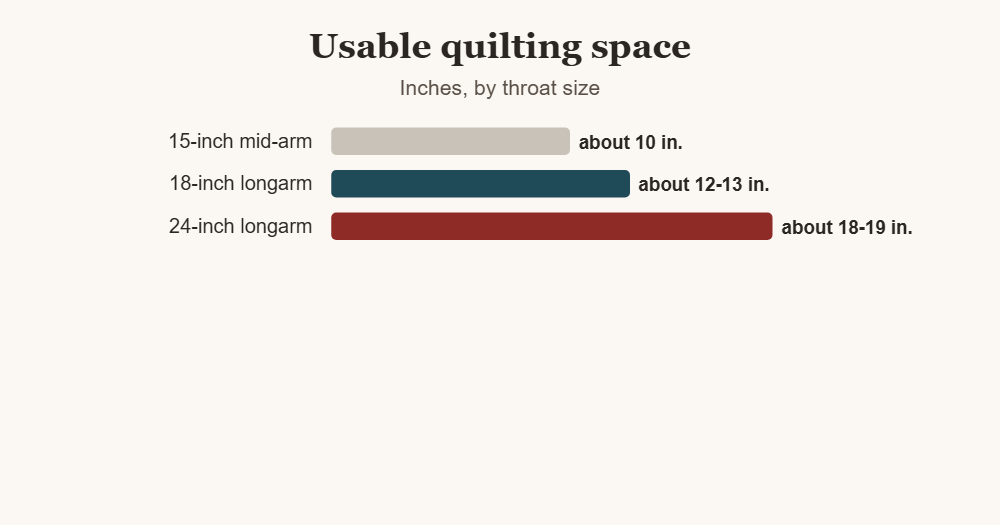
| Throat size | Category | Usable quilting space (about) | Source |
|---|---|---|---|
| 15 in. | Mid-arm | About 10 in. on a frame | Sewing Machines Plus |
| 18 in. | Entry longarm | About 12–13 in. | HC Quilts |
| 24 in. | Mid-size longarm | About 18–19 in. | HC Quilts |
| 30 in. | Large longarm | More, varies by frame | Longarm University |
Usable space is less than throat size, because frame rails take up room.
Handi Quilter notes that throat space and quilting space are not equal. Linda’s Electric Quilters ranks throat space as a top priority because it cannot be added later.
Sit-down or frame-mounted longarm?
A frame-mounted longarm moves over a quilt that is rolled on a frame. A sit-down (stationary) longarm stays still on a table while you move the quilt under the needle. Both have long throats; they differ in how you work.
| Frame-mounted | Sit-down | |
|---|---|---|
| What moves | The machine | The quilt |
| Room needed | A frame from about 5 to 12 feet long | A table, like a large sewing desk |
| Best for | Edge-to-edge and computerized quilting, big quilts | Free-motion work, smaller rooms |
| Examples in US results | Handi Quilter Moxie XL with frame, Janome Quilt Maker Pro 20 | Grace 19SD, Baby Lock Gallant XL Stationary |
Setup types as described by Baby Lock and Google’s AI summary, United States, 28 November 2026.
Compact frames can still finish a king quilt by working zone to zone, one section at a time. It takes longer, but it saves room.
Frame size and room size
The frame sets the largest quilt you can load. Frames commonly run 8 to 14 feet long, and you need walking room on both sides.
Handi Quilter lists frames of 8 to 10 feet for its Moxie models and 10 to 14 feet for the Amara 24. A king quilt needs a long frame. Measure your room, then add space to walk around the frame on both sides before choosing.
Stitch regulation and computerized quilting
Stitch regulation keeps stitches the same length no matter how fast you move the machine. Computerized systems move the machine for you, following a digital design.
- Stitch regulation helps hand-guided quilting look even. Most modern longarms include it.
- Computerized guidance, such as Handi Quilter’s Pro-Stitcher, quilts digital patterns automatically.
- Speed varies: Handi Quilter lists 1,800 stitches per minute for the Moxie and 2,500 for the Amara 24.
Computerization adds a large part of the price on high-end systems.
What does a longarm cost?
New longarms run from about $5,000 for an entry mid-arm to over $30,000 for a large computerized system. Price follows throat size, frame and software.
| Handi Quilter model | Throat | Listed from |
|---|---|---|
| Moxie | 15 in. | $4,995 |
| Moxie XL | 18 in. | $7,995 |
| Amara 20 | 20 in. | $12,995 |
| Amara 24 | 24 in. | $19,995 (up to $33,990 with options) |
Handi Quilter’s listed prices in 2026; dealers run sales, and frames and computers change the total.
Gammill, APQS, Nolting and Grace also make longarms. APQS advises buyers to pick a company for the long haul, because dealer support and training matter for years.
Longarm prices across brands in 2026
Most longarms cost about $3,500 to over $30,000. Compact 15 to 16 inch machines start near $3,500 on sale; 20 inch and larger machines with frames and automation run $10,000 and up.
Team Joy’s Fabrics reviews and researches these products; we have not tested them.
| Machine | Throat | Price seen |
|---|---|---|
| Grace Q’nique 16X | 16 in. | About $3,559 on sale |
| Handi Quilter Moxie XL with frame | 18 in. | About $3,995 on sale; $5,495 regular |
| Janome Quilt Maker 15 | 15 in. | About $4,995 |
| Grace Q’nique 16X Elite | 16 in. | About $4,359 on sale |
| Grace 19SD with sit-down table | 19 in. | About $5,599 on sale |
| Baby Lock Gallant XL Stationary | 18 in. work space | $6,499 special; $7,864 regular |
| Bernina Q 16 PLUS | 16 in. | From $6,999 on sale |
| Grace Q’nique 21X Elite | 21 in. | About $8,359 on sale |
| APQS Ellie | Not listed | About $8,400 |
| Janome Quilt Maker 18 | 18 in. | About $8,495 |
| Bernina Q20 | 20 in. | About $10,499 on sale |
| Juki Miyabi J-350QVP with 5 ft frame | 10 in. vertical height | About $10,799 and up |
| Gammill hand-guided system | Varies | From $16,499, with delivery and training |
| Janome Quilt Maker Pro 20 with 12 ft frame and Pro-Stitcher | 20 in. | About $19,999 on sale |
Prices from Google Shopping, brand sites and Google’s AI summary for “longarm quilting machine”, United States, 28 November 2026. Black Friday prices; regular prices are higher.
Sale prices swing by thousands of dollars around holidays. If you are not in a hurry, watch prices for a few weeks before you buy.
Buy, rent or send out?
If you finish only a few quilts a year, renting time on a longarm or paying a longarm quilter may cost less than buying. Buy when you quilt often or want to quilt for others.
| Option | Good when |
|---|---|
| Buy a longarm | You finish many quilts a year or quilt for others |
| Rent longarm time | You want to quilt your own tops a few times a year |
| Send to a longarm quilter | You prefer piecing and want a professional finish |
Joy Press’s finished quilts show two of these paths: some she quilted herself, and some were quilted by Kathy Olson or David Beers. Several of Joy’s Bargellos list the Time Warp pantograph.
Is a longarm worth it for a hobby quilter?
A longarm is worth it if you finish many quilts a year and enjoy the quilting step. If you quilt a few tops a year, renting time or sending quilts out usually costs less.
That is the split in Reddit’s r/quilting threads. Hobby owners say they quilt gifts and their own tops and do not regret it. Others say they would never finish enough quilts to pay off the machine.
Do the math before you buy:
- Count your quilts. How many tops do you finish in a year?
- Price the alternative. Ask a local shop what it charges to rent a longarm by the hour, or what a longarm quilter charges per quilt.
- Divide. Machine price divided by what you would spend each year on rental or services tells you how many years it takes to break even.
- Check the room. A frame needs floor space you will give up for years.
Renting longarm time before you buy
Many quilt shops rent time on their longarms, usually after a short class. It is the cheapest way to learn whether you like longarming.
Quilters on r/quilting describe renting time at shops, and one reported that a county library near them lends a longarm free after a training session. One Canadian quilter reported paying $125 CAD for six hours. Prices and rules vary, so call shops near you.
Buying a used longarm
Used longarms sell for much less than new, and many come with a frame. They are worth a look if you can see the machine run before you pay.
- Ask the seller to stitch on a test sandwich while you watch.
- Ask whether a dealer will service that brand and model near you.
- Check what is included: frame length, stitch regulator, computer system.
- Plan how you will move it; frames and machine heads are heavy.
Questions to ask before you buy
Ask the dealer about throat space, frame length, stitch regulation, training, service and upgrade paths. Try machines in person before you commit.
- What quilts will I make most: lap, queen, king?
- How much room do I have, with space to walk around the frame?
- Do I want computerized quilting now or later?
- Is training included, and where is the nearest service?
- Can I upgrade the frame or add a computer later?
Related guides: the batting you load matters as much as the machine, so see cotton quilt batting. For the cutting side of the studio, see the Olfa rotary cutter guide.
What to do next
Measure your room, decide the largest quilt you will make, and set a budget that includes the frame and any computer. Then try machines at a dealer or quilt show before buying, paying close attention to usable quilting space. If you are not ready to buy, consider renting longarm time or sending your top to a longarm quilter. Read our best sewing machine for quilting guide for home-machine options, and see the full quilting supplies guide.
Longarm quilting machine questions
What is the minimum throat size for a longarm?
18 inches, according to Sewing Machines Plus. Smaller machines are mid-arms or short-arms.
How much does a longarm quilting machine cost?
From about $5,000 for an entry model to over $30,000 for large computerized systems, based on Handi Quilter’s 2026 listings.
How much room does a longarm need?
The frame length, often 8 to 14 feet, plus walking space on both sides.
Is an 18-inch longarm big enough?
For many quilters, yes. It gives about 12 to 13 inches of usable quilting space, according to HC Quilts.
Has Joy’s Fabrics tested these machines?
No. This guide is based on our research of manufacturer and dealer information.